Settlement funds received by the City of Portland from a nationwide lawsuit against several opioid manufacturers and distributors could go towards paying drug users cash to incentivize them to properly dispose of their used syringes.
The City of Portland has already received roughly $750,000 in settlement payments from the lawsuit, and will also receive approximately $235,000 annually between fiscal year 2025 (FY25) and FY39, according to a memo from Portland City Manager Danielle West.
The Portland City Council’s Health and Human Services (HHS) and Public Safety Committee will meet on Tuesday to discuss and take public comment on the allocation of the opioid settlement funds for FY25.
One of the proposals that is slated for consideration is a pilot “syringe buyback” project, which would involve the city’s syringe exchange program paying drug users cash when they return used syringes.
Two other proposed uses for the funds involve the creation of a “low-barrier” daytime homeless shelter, and providing seed funding for an on-peninsula methadone clinic in Portland to treat opioid withdrawal.
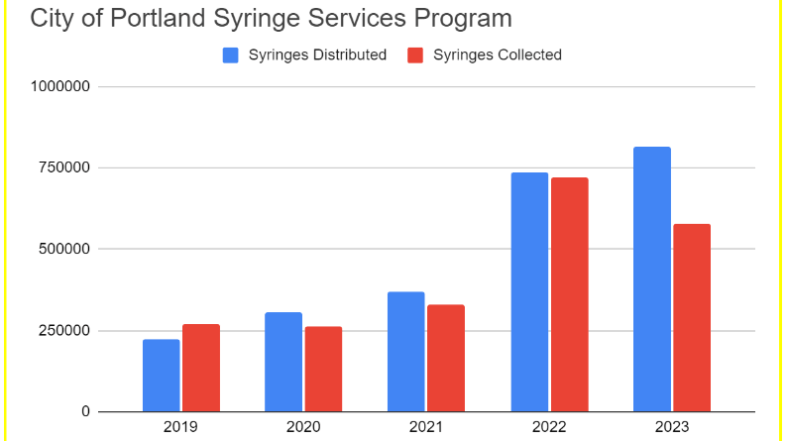
Portland’s Syringe Service Program (SSP), commonly referred to by the city as “The Exchange,” currently gives out tens of thousands more syringes than they collect.
Data presented to the committee earlier this year by the city staff showed that from January to May 2024, the needle exchange had distributed nearly 260,000 sterile syringes — about 75,000 more than they collected.
The number of collected syringes includes the improperly disposed of needles that litter the streets, sidewalks and parks in Portland and are regularly cleaned up by city staff.
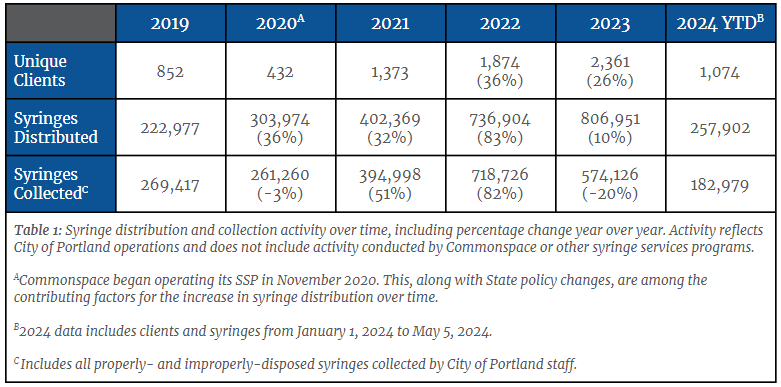
A rule change issued by the Maine Center for Disease Control (CDC) in 2022 allowed SSPs throughout the state to distribute up to 100 syringes per client, which has resulted in a marked increase in the number of needles given out by the city.
The Maine CDC also removed the requirement for SSP clients to return a used syringe in order to receive a sterile one.
With the increase in the number of distributed needles, so have reports of improperly discarded syringes littered on public and private property in the city.
The proposed “syringe buyback” program, as outlined in a city memo, would be modeled after similar programs implemented in Boston and New York City, and would involve a payout of five cents per used syringe returned to the exchange.
As proposed, the buyback program would be a year-long pilot beginning in January 2025, and would be funded by $52,000 — allowing for roughly one million used syringes to be bought back by the city.
Daily and weekly limits would be placed on the number of syringes the buyback program participants could return in exchange for cash.
Portland city staff proposed a $10 daily payout cap per client — equivalent to 200 syringes — and a maximum $20 weekly payout per client — or 400 syringes.
For the entire program, a maximum of $500 could be paid out per day, and $1,000 per week, as proposed by city staff.
The buyback program is not the only measure being considered by the committee related to addressing syringe litter in Portland.
In a memo to the committee from Portland’s Interim Public Health Director Bridget Rauscher, a variety of other strategies for combating the problem of needles littered throughout the city are presented.
One strategy, the “Harm Reduction Ambassadors program,” is described as the city compensating the clients of the syringe exchange to conduct education and outreach.
The city has also attempted to bolster syringe cleanup operations by placing additional sharp containers throughout the city, increasing the staff hours spent on cleaning up needles by an extra hour each weekday, as well as creating a “Syringe Littler Hotline” for Portland residents to report improperly discarded needles.
The Tuesday meeting of Portland’s HHS and Public Safety Committee will be held remotely via Zoom starting at 5:30 p.m. The committee will be taking public comment on the allocation of the opioid settlement funds.

0 Comments