
Democratic U.S. Senate candidate Graham Platner continued his statewide campaign Wednesday with a well-attended rally in Cumberland, where supporters gathered despite oppressive summer heat to hear a speech centered on economic inequality, health care, housing, campaign finance reform and what he described as the need for sweeping political change.
Speaking for roughly 40 minutes, Platner delivered remarks that echoed many of the themes he has emphasized throughout his Senate campaign, sharply criticizing President Donald Trump, billionaire entrepreneur Elon Musk and incumbent U.S. Sen. Susan Collins while arguing that the nation’s political and economic systems increasingly favor wealthy interests over working families.
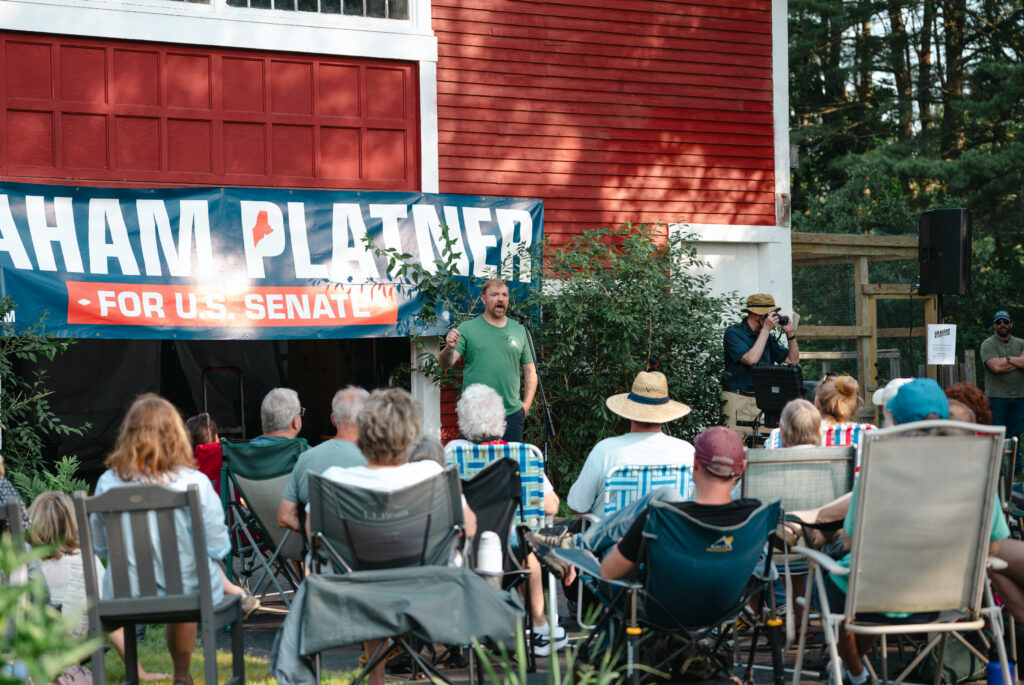
The event drew a sizable crowd despite temperatures climbing into the 90s. Before Platner took the stage, supporters described him as a candidate who spends time listening to voters and engaging in conversations rather than simply delivering campaign speeches.
When Platner addressed the crowd, he thanked supporters for attending despite the heat before outlining what he said was a campaign focused on rebuilding trust in government.
“I think we have to do politics so much differently,” Platner said. “Our political system has really become one of performance and theater.”
Throughout his remarks, Platner argued that many Americans have become frustrated with politics because they believe elected officials are more responsive to corporations, wealthy donors and special interests than to ordinary voters.
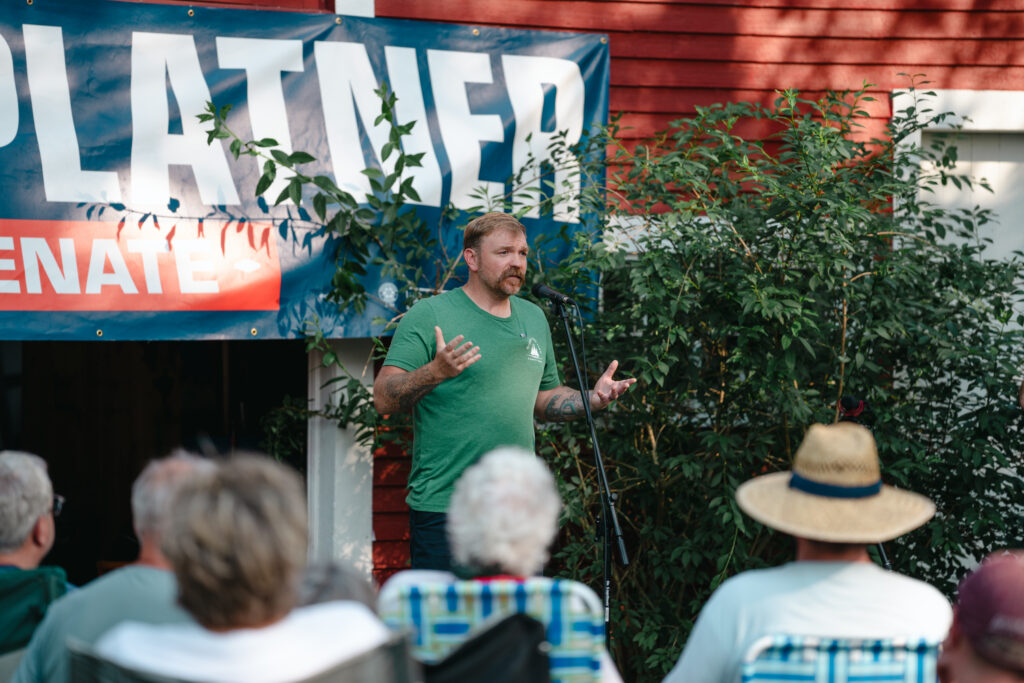
Drawing on conversations he said he has had while campaigning across Maine during the past 10 months, Platner said Republicans, Democrats, independents and politically disengaged voters have expressed similar frustrations with Washington. According to Platner, many Mainers feel government no longer represents their interests.
That message has become a defining theme of Platner’s campaign as he seeks to unseat Collins, who is running for another six-year term after first being elected to the Senate in 1996.
Much of Platner’s speech focused on what he described as the economic struggles facing working families in Maine.
He argued that rising housing costs, declining access to rural health care, aging infrastructure and increasing wealth inequality have left many Mainers working harder while falling further behind financially.
Platner pointed to the consolidation of hospitals and the loss of maternity services in rural Maine as examples of declining access to health care. Reflecting on his upbringing in eastern Maine, he said communities once had more local medical services than they do today.
Housing affordability was another major focus of his remarks.
Platner argued that many young Mainers can no longer afford to purchase homes in the communities where they grew up and said rising rents have forced some families to postpone homeownership or leave the state in search of greater economic opportunity.
He contrasted those challenges with the growing fortunes of some of the nation’s wealthiest business leaders, including Musk, arguing that decades of federal policy have contributed to widening income and wealth inequality.
Platner also criticized financial deregulation and other federal economic policies adopted over several decades, arguing that they shifted economic benefits toward large corporations and investors while leaving working families behind.
Again and again, Platner tied those concerns back to Collins, contending that Washington has failed to adequately address the economic pressures facing Maine families during her nearly three decades in office.
As an alternative, Platner called for what he described as a new era of ambitious federal investment modeled after President Franklin D. Roosevelt’s New Deal.
He praised Frances Perkins, the Maine native who became the first woman to serve in a presidential Cabinet, crediting her with helping establish Social Security and expand workplace protections during the Roosevelt administration.
Among the policy priorities Platner highlighted were universal health care, expanded public education through college and trade school, overturning the Supreme Court’s Citizens United decision, prohibiting members of Congress from trading individual stocks, strengthening organized labor and increasing federal investment in infrastructure and energy projects.
Rather than asking supporters only for their votes, Platner repeatedly encouraged them to become active participants in the campaign.
He said his campaign has built a volunteer network of approximately 15,000 people and urged attendees to continue organizing in their communities, arguing that major political reforms throughout American history have come through sustained grassroots activism.
Throughout the speech, Platner cited the labor movement, the women’s suffrage movement, the civil rights movement and other historic social movements as examples of citizens organizing to bring about lasting political change.
The race between Platner and Collins has become one of the nation’s most closely watched Senate contests, with national Democrats viewing Maine as a key pickup opportunity and Republicans defending one of their longest-serving incumbents.
Collins has campaigned on her record of securing federal funding for transportation projects, military installations, health care facilities, economic development initiatives and coastal infrastructure across Maine, while emphasizing her seniority and bipartisan relationships in the Senate.
Recent public polling has shown a competitive race. One recent statewide survey found Collins holding a narrow lead over Platner, while other recent polls have shown the contest within the margin of error.
Although Platner focused heavily on housing, health care, infrastructure and economic opportunity, he did not discuss the respective roles of state and federal government in addressing many of those issues, several of which involve shared responsibilities among state agencies, the Legislature and Congress.
Platner concluded by urging supporters to continue building what he described as a broad grassroots coalition capable of carrying the campaign through Election Day and beyond, arguing that the effort is about more than a single Senate race and should become part of a larger movement for political reform.
Maine Wire Reporter Confronted While Covering Event
Before Platner began speaking, this Maine Wire reporter covering the public campaign event was approached by campaign staff and told he needed to leave after one staff member referred to him as a “paid agitator.”

The reporter identified himself as a member of the media covering the event and advised campaign staff that he was there to report on the candidate’s remarks.
Campaign staff later stood between my camera during portions of the event, making it difficult to record Platner’s speech. The interaction was recorded live the Maine Wire TV, and video of the encounter will be published separately.




0 Comments