
Ranked choice voting is set to be used for the upcoming June 9 primary election for which a number of key races will be on the ballot.
Although ranked choice voting has proven to be a point of significant controversy since its initial implementation several years ago, it is nonetheless the system in place for this month’s election.
Consequently, it is critical that Mainers understand how best to approach filling out their ballot so that their vote is able to be as effective as possible and can be counted in accordance with their desires.
On the ballot this cycle are several important races, including for the governorship, as well as for one of Maine’s seats in the United States Senate and both of the state’s seats in the United States House of Representatives.
Both Democrats and Republicans will be asked to weigh in on primary races for the gubernatorial election and the senatorial election, but only Republicans will be faced with a choice at the ballot box for the House seat.
Because ranked choice voting will be in place for these races, voters will have the option to express support on their ballot for multiple candidates.
In the event that one candidate does not receive at least 50 percent of the votes cast, the candidate with the fewest amount of votes will be knocked out of the running.
Votes would then be distributed to whichever candidates were marked as a second choice on ballots cast by those supporting the eliminated candidate.
This process continues until one candidate emerges with majority support, or at least fifty percent of the votes.
With a ranked choice ballot, there are several valid ways that a vote can be cast.
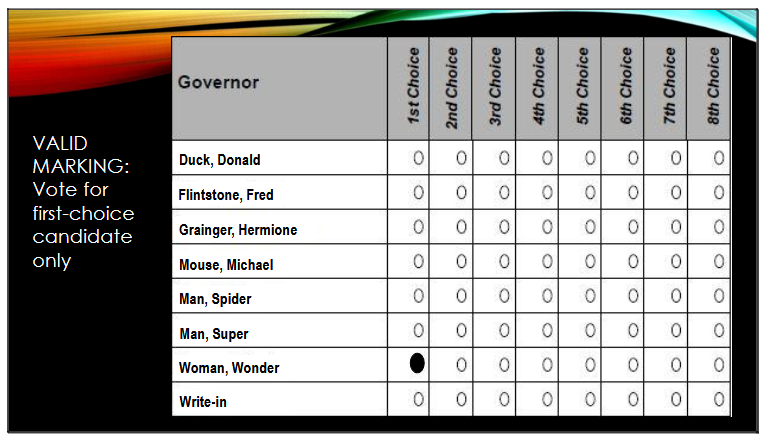
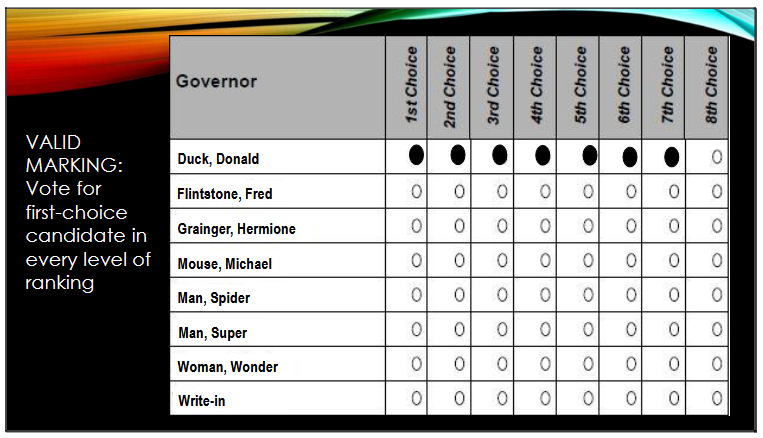
For those who do not wish to participate in ranked choice voting, Mainers have the option to only fill in a first-choice selection on their ballot, or alternatively, to fill in each ranking slot for the same candidate.
Voters who opt to do that, however, run the risk of having their voice eliminated from the election in the event that their chosen candidate is taken out of the running.
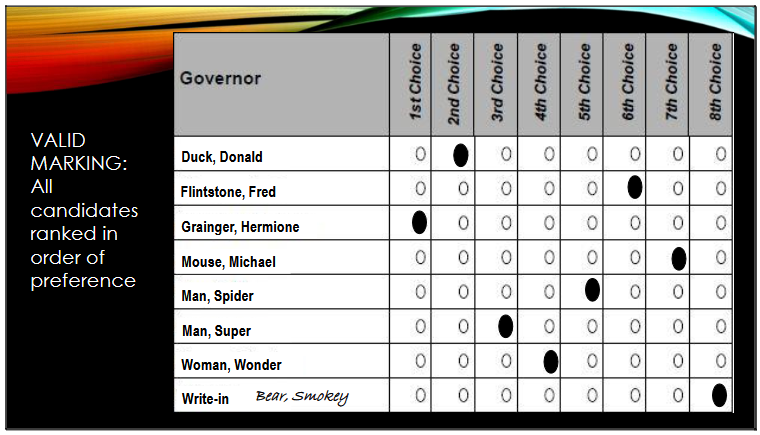
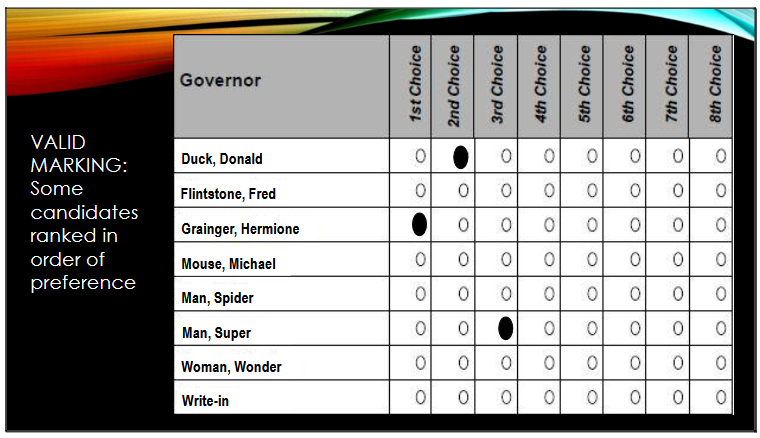
If there are multiple candidates that a voter would like to support in the race, voters may rank them in order of preference. By doing so, a voter’s ballot continues to be counted if the first choice candidate is eliminated.
Voters can choose to rank as few or as many candidates as they would like.
These images provided by the Secretary of State’s Office illustrate several examples of valid ranked choice ballots.





0 Comments