
Interview with Jerry Leeman:
Today we bring you a story about a handful of fishermen rallying against a billion-dollar green industrial project, shady foreign corporations, and our own federal and state government. All are conspiring to generate a cash cow for themselves paid for by the hapless electrical consumer and taxpayers. Standing against that juggernaut are fishermen with generations of real-life experiences on the water. Their efforts started to save their jobs and their way of life by taking a stand against government overreach. Due to the recent efforts to develop part of their fishing grounds into a wind farm their quest has expanded to include protecting the ecosystem in the Gulf of Maine from an industrial machine that may destroy it and the whales, dolphins, fish, and birds that depend on it.
Guy Lebida, Editor of The Maine Anchor interviewed Jerry Leeman, Founder & CEO of the New England Fishermen’s Stewardship Association, which is a bipartisan, non-profit organization committed to uniting Americans in the fight to preserve what could be the last wild frontier-the ocean, where fresh, wild, protein-rich, American seafood that nourishes our nation is harvested. This piece attempts to bring some of the information from that interview in a brief, organized, and easy to understand narrative. In many cases the questions and answers are paraphrased to develop the narrative. The story line, supporting studies, benefits, known and unknown risks, and performance of other wind farms are discussed.
What are the stated benefits of this project?
The only claimed benefit to Mainer’s is job creation. Using Sears Island as an example, they represent this number in 33,000 job years. This project has a 20-year lifespan. Thirty-three thousand is a big number but it puts our lobster industry, our third largest industry, at risk. We have 5,000 lobstermen who will work 30 years which is 150,000 job years. It is multi-generational and can be passed to the next generation for another thirty years.
What about the reduction of global warming?
Appendix A of the government report states that it is anticipated that there will be no collective impact on global warming as a result of offshore wind projects.
What about the cost of electricity?
Floating offshore power is double the price of fixed offshore power and New York fixed offshore power cost went up by 3.5 times. Electrical prices will go up as these windmills come online.
If this project does not reduce global warming or prices who profits?
The manufacturers of the components, many of them overseas, the construction companies that build it and the owners who are guaranteed above market rates for the electricity.
Okay, so there is not much to gain from an environmental or financial standpoint, what are the risks?
First, let’s start with the known risks and it is important to note the magnitude and effect on the local environment and the net effect in the Gulf of Maine is not known. There is a potential for dead zones like those found in Galveston Texas and toxins entering our aquaculture and wild fishing stock and ending up on our dinner tables.
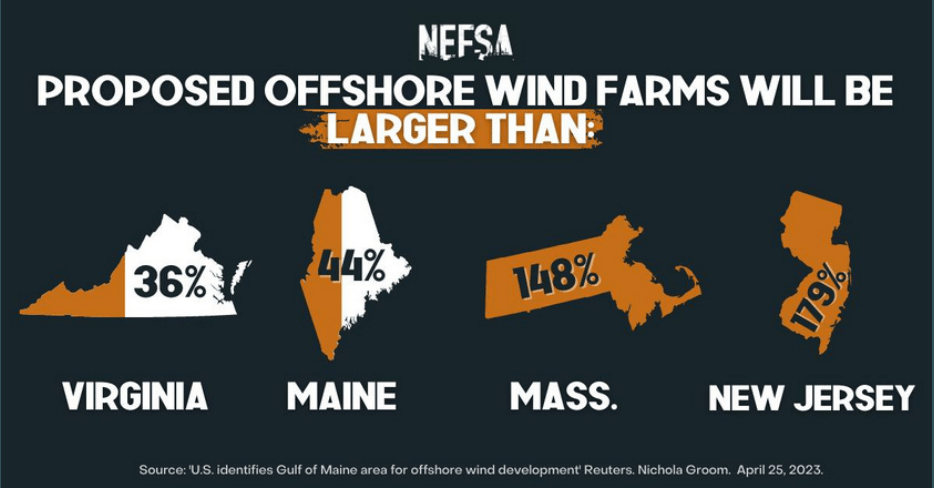
The first item is not a risk, it is a given.
Fishermen will lose 20% of their fishing grounds in phase 1, if we continue, phase 2 starts in 2028. The only question is the ultimate survival of the industry.
Sediment plumes
Each platform will have roughly three miles of chain. Changing wind direction will drag these massive chains across the bottom destroying everything down there and putting silt and sediment plumes into the water which chokes out life. A good example of that is Galveston Texas with muddy water and a thirty-mile dead zone.
Discharge of heated toxic water
Some components require cooling water. The cooling stations are fixed structures and look like oil rigs. The report says each of the stations will require 8.1 million gallons per day. This water is picked up near the bottom at 45-50 degrees and is chlorinated to kill any marine growth in the cooling system. The heated and chlorinated water is discharged near the surface at about 90 degrees. If 18 units are installed it will mean the discharge of 145 million gallons of heated and chlorinated water into the environment every day. The effect is accumulative as windmills are built. Tidal flow is not like a river that carries everything away. The mass of water moves back and forth and some of the contaminants come back. No one knows what the net effect will be.
Fixed hazards to sea life
There will be hundreds of vertical cables, pipes, and chains going from the surface to near the bottom. Not only are these a hazard to fish and whales, they will also result in the introduction of species not native to that environment, that is the definition of an invasive species. They will compete with the normal sea life and will affect the echo system.
Negative impact on migration and growth cycles
The lines transmitting power to the shore may affect the growth cycle and migration of lobsters, elvers, and fish. Again, the magnitude is not known.
There are also unavoidable risks and consequences.
Bird and potentially bat kills
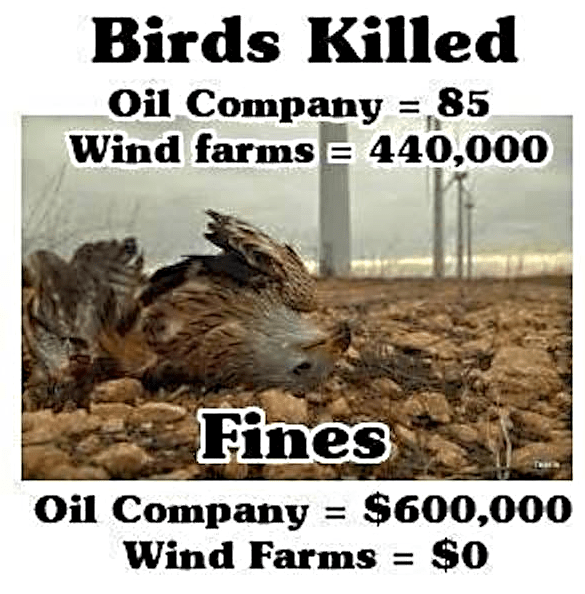
Windmills are deadly to birds. Eagles, ospreys, puffins, blue heron, gulls and migrating birds are at risk. Due to their migration paths, we could lose our reestablished puffins. Below the water migrating whales will have to navigate around various hazards in an environment with noise and electromagnetic fields which may affect their agility to navigate.
Release of chemicals
The fiberglass blades contain bisphenol A. It can affect human and animal fertility. The blades are eroded due to the wind and particles in the air. The eroded material ends up in the water, gets into the food chain, and can end up on our dinner table.
Risks to fishermen and structures
Boats will have to travel along narrow identified travel paths. The installations cause radar interference, in low visibility conditions it brings risk to all vessels and the windmills themselves. A single accident could cost lives and cause the permanent shutdown of the travel lanes. The insurance companies have been asked and an answer has not been forthcoming. If these lanes were closed it would have a very negative impact on fishing.
Sediment plumes during construction - This power has to come ashore to a 345,000-volt substation. Two locations are identified these are Wiscasset and Cousins Island. Hydro dredging will be required to lay those lines. The Cousins Island dredging will disturb coal ash, which was dumped there years ago, and the Wiscasset site will disturb sediment that may contain contaminants from Mason Station and Maine Yankee. In either case massive amounts of sediment, some containing coal ash and others containing chemicals will be released into the environment from dredging.
Transmission of electricity on the bottom -The effect of transmitting hundreds of megawatts of electricity has been shown to negatively affect sea life. Both the dredging and transmission of power may impact local aquaculture and fish, oysters, and eel (elver) life cycles. We have the potential to lose whole migrations and species. If these contaminants get into the food chain, then people will be eating it.
Next category is potential accidents and failures.
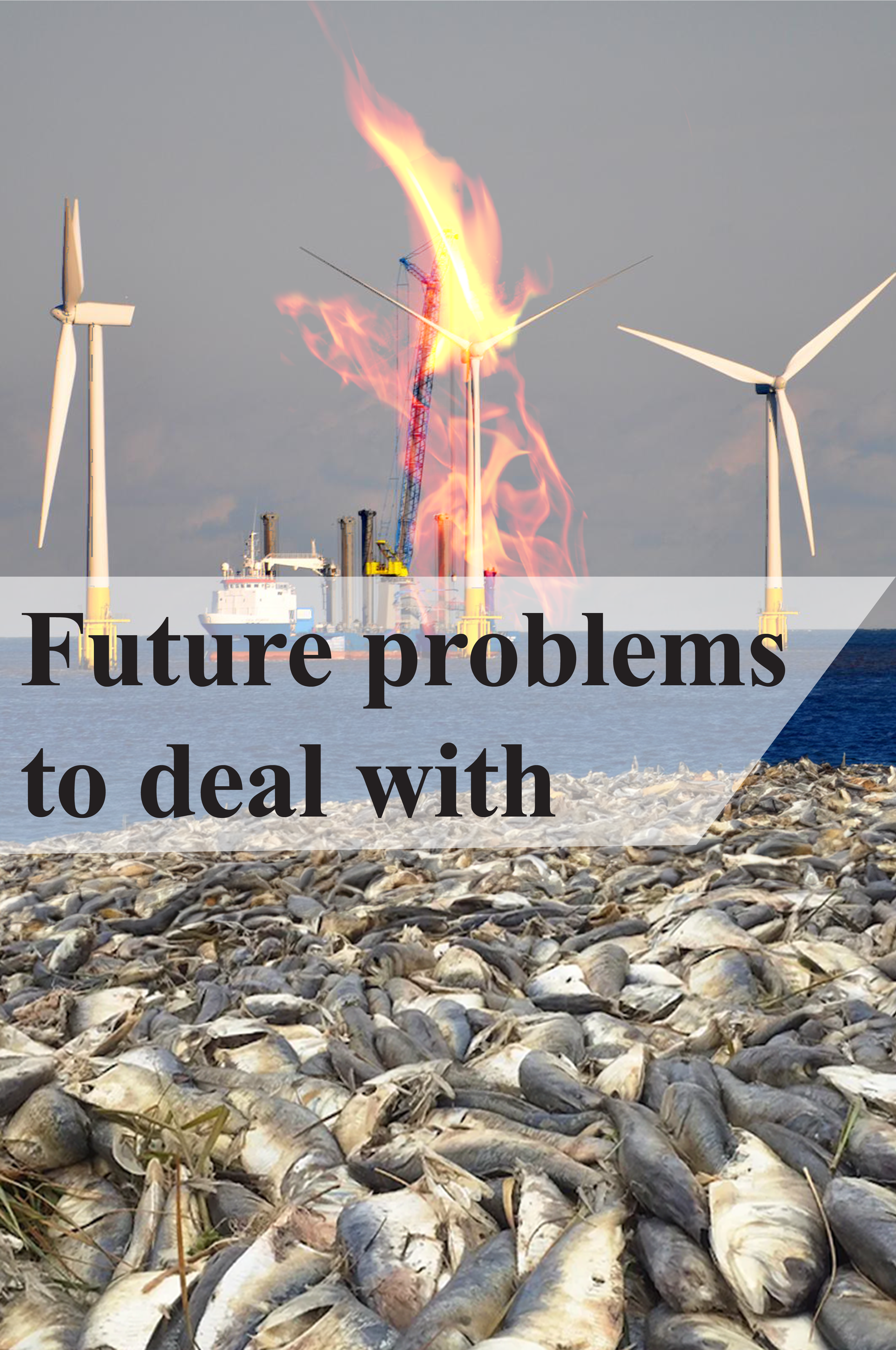
The repair process itself will have some negative impact on the ecosystem. The fiberglass blades contain toxic material. The recent blade failure at Vinyard wind is an example. Who is picking up the fiberglass off the ocean floor? Chemicals and small particles can end up in the water and be ingested and pass through the food chain to humans. There is a risk to the perception of the clean and pure ocean waters of Maine. This could affect the marketability of our seafoods and have a devastating effect on our economy and an impact on our health.
Lastly is the unexpected.
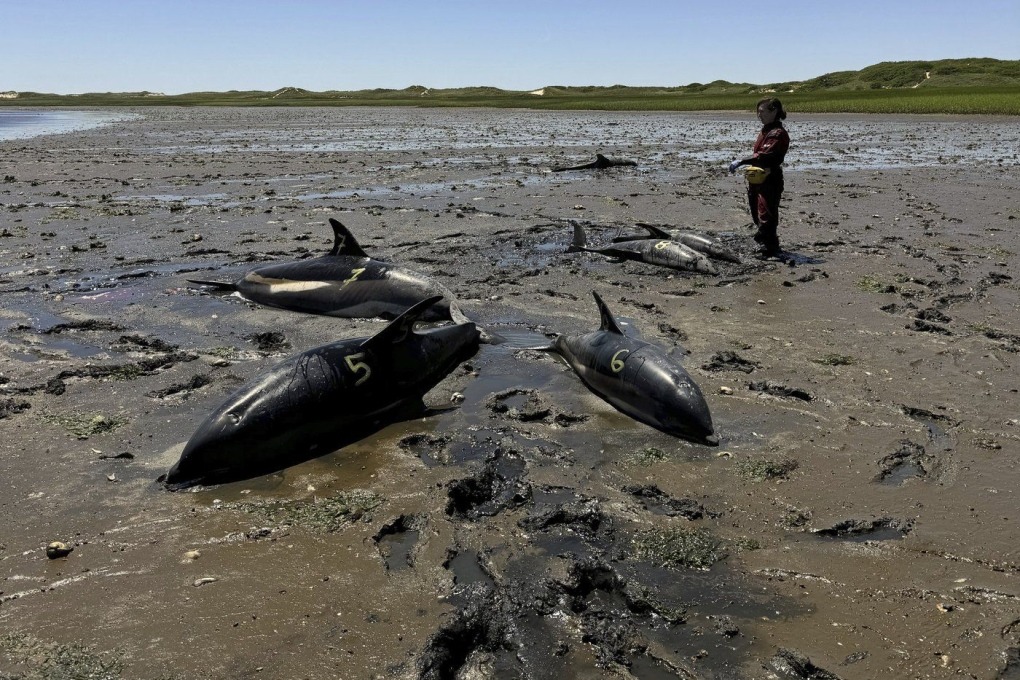
Dead whales and dolphins are now washing up on the beaches of Massachusetts. Seismic air guns are used in mapping the bottom for instillation of components of wind farms. Seismic air guns put out 268 decibels (Db). A jet engine at 20 yards puts out 120 Db. A sound level of 140 Db causes instant damage to the human ear and a reading above 160 is considered beyond painful. It is claimed that whales, without the ability to hear, die. Whale deaths in this area before use of seismic air guns were rare. I believe that there have been around 30 deaths recently. Additionally, this June over 100 dolphins became stranded off Cape Cod. It is the largest dolphin stranding in U.S. history. There is no reliable data on any of the listed risks to be able to quantify what the environmental damage will be. A letter from NOAA to Karen Baker, the head of the Bureau Ocean Energy Management states “we have no baseline data”. Our own government admits they don’t know where we are. As it stands much of the data was collected from fishermen in an unscientific and unreliable process. The negative impact on Sealife at most is an “educated” guess. We were originally told that we were going to have a mockup for 12 turbines and get an EIA assessment prior to the larger buildup and would stop if there was a negative impact. That changed and now it looks like they are going to dump money in and there is no turning around. The schedule does not allow time for an assessment or even the establishment of a red line – a quantity of environmental damage that is unacceptable and will result in the termination of the project. What we have now is a blank check to proceed and a lot of guesses.
We are committing billions of dollars of taxpayers and electrical customers dollars for a project that will not reduce global warming, will raise electrical rates, will cause an unknown amount of environmental damage, will cause unknown damage to our fishing industry and may ultimately cost more jobs than it produces. It has the potential to end our fishing industry, an industry that has existed for hundreds, if not thousands of years, and our government admits we don’t know where we are or where we are going.
The people that approved this bill, 130th session, LD 336, and 131st session LD 1895, did not understand the risk. As more information comes out more questions are raised and no answers are forthcoming. Not so long ago we thought putting sludge on our fields was a good idea. This project has the potential to be a disaster for our environment and the people of Maine. We should stop this project until we understand the risks.


0 Comments