
There’s an old saying in Washington that goes “where you stand is where you sit,” which is to say too much of the federal government’s time and our tax dollars are wasted every day on bureaucratic infighting. If his planned streamlining of America’s oldest federal department goes forward, Secretary of State Marco Rubio might change that.
“In its current form, the Department is bloated, bureaucratic, and unable to perform its essential diplomatic mission in this new era of great power competition,” Secretary Rubio asserted on Tuesday. “Over the past 15 years, the Department’s footprint has had unprecedented growth and costs have soared. But far from seeing a return on investment, taxpayers have seen less effective and efficient diplomacy. The sprawling bureaucracy created a system more beholden to radical political ideology than advancing America’s core national interests,” he continued.
State Department employees — of whom there are some 30,000 — have long referred to Main State, or the headquarters located at 300 C Street, NW, as “The Building.” By doing so, they are implicitly admitting that is massive bureaucracy is bigger than an individual and will invariably crush any effort to change the way things work. That is why occupants of “The Building” often wear tired, hopeless expressions as they trudge woefully down its long corridors.
Once during my short stint at State in 2008, I had the honor of escorting then secretary Condoleezza Rice from her office on the pre-eminent seventh floor to a commission meeting on the first. The walk alone took us fifteen minutes, which, while I cherished as my brush with greatness, she might have thought herself at the time — like past secretaries before her — something of a hostage.
Her current successor signaled his intention to trim the sails on the ship of State at the same time the U.S. Agency for International Development (USAID) was essentially dissolved a couple months ago. Judging by the new design for Main State, it was not eliminated altogether but rather right-sized:
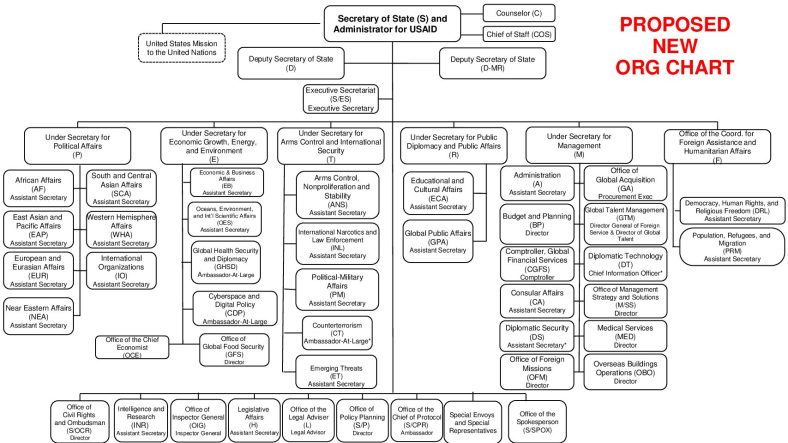
“That is why today I am announcing a comprehensive reorganization plan that will bring the Department into the 21st Century,” Rubio explained in unveiling the new organization chart. “This approach will empower the Department from the ground up, from the bureaus to the embassies. Region-specific functions will be consolidated to increase functionality, redundant offices will be removed, and non-statutory programs that are misaligned with America’s core national interests will cease to exist,” he elaborated.
Gone is the dreaded Global Engagement Center (GEC) which, renegade journalist Matt Taibbi must be delighted to learn, doesn’t exist in the new plan.
Two years ago, Taibbi testified to a House committee about how the GEC was weaponized against American journalists who disagreed with the Biden administration. As thanks for speaking candidly before an elected committee, the IRS was dispatched to Taibbi’s home afterwards. Probably just a goofy coincidence.
There is a role for public diplomacy just as there is for a foreign broadcasting service to help disseminate America’s message around the world, but these functions need to be integrated into a system that works for the American people.
Under the new scheme, the undersecretary for whom I used to work — created under George H.W. Bush to oversee democracy and global affairs — no longer exists either. But the Bureau of Democracy, Rights and Labor has, despite grim rumors, survived and been put under the direction of a coordinator for foreign assistance. That makes sense.
So too does the role that has by design the most powerful under the secretary themselves: P or the undersecretary for political affairs, who overseas the seven regional bureaus that span the globe. Too often in practice though, P played second fiddle to M, the undersecretary for management, or The Building’s black belt of administration. Here both are co-equal with the undersecretaries for arms control and international security, economic development, and public diplomacy and public affairs. None of these lines of authority should be stove-piped, rather, under an effective secretary they ought to be integrated with one another.
Speaking of effective secretaries, the one who leaps to mind is Colin Powell. When he arrived at “The Building” after eight mercenary years of the Clinton regime, the scene was compared by witnesses to the liberation of Paris in 1945. When Powell had a question, he would call down to the relevant desk officer because, as a military commander, who knew where to find answers. Rubio would be wise to take note if his re-organization goes forward.
Rex Tillerson, President Trump’s first secretary of state during his first term came from the corporate bureaucracy and didn’t last long against the more entrenched bureaucracy of The Building, despite his own hopes of reform. In the George W. Bush administration, the sharp-elbowed Defense Secretary, Donald Rumsfeld, worked in cahoots with Vice-President Dick Cheney to sideline the popular, and generally more cautious Powell. If Rubio is to succeed in his ambitions, he will need support from 1600 Pennsylvania Avenue just a few blocks down the street.
Without such support, The Building might as well be in Siberia.



0 Comments