
Democrat Reps. Chellie Pingree (ME-CD1) and Jared Golden (ME-CD2) had very different outlooks after President Donald Trump announced his controversial “Liberation Day” tariffs on Wednesday, causing stock markets to plummet. The ultimate goal was to restore U.S. economic independence and end the exploitation of the U.S. by other nations.
Rep. Pingree sided with most Democrats in criticizing the new tariffs and claimed that they will do nothing to help struggling Americans.
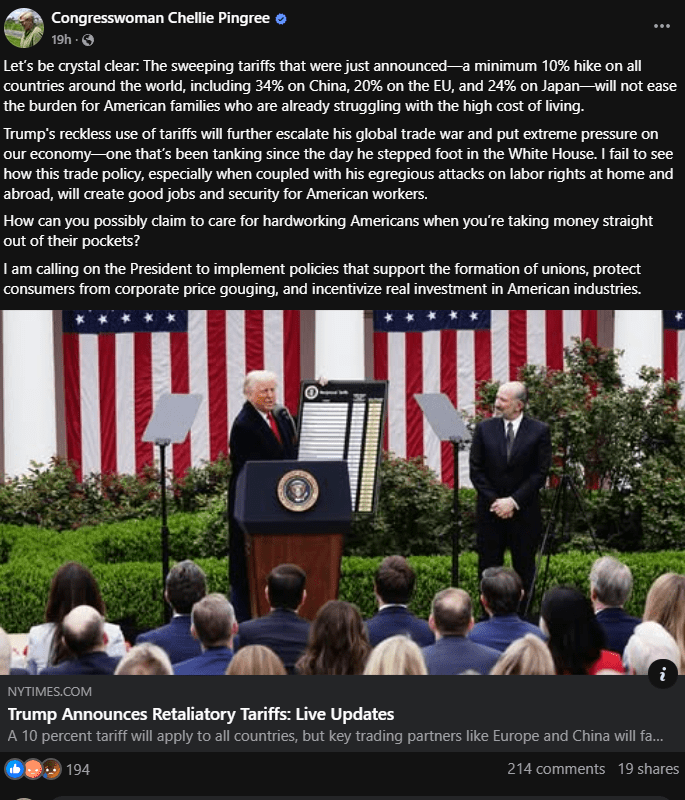
“Trump’s reckless use of tariffs will further escalate his global trade war and put extreme pressure on our economy—one that’s been tanking since the day he stepped foot in the White House. I fail to see how this trade policy, especially when coupled with his egregious attacks on labor rights at home and abroad, will create good jobs and security for American workers,” said Pingree on Facebook.
“How can you possibly claim to care for hardworking Americans when you’re taking money straight out of their pockets? I am calling on the President to implement policies that support the formation of unions, protect consumers from corporate price gouging, and incentivize real investment in American industries,” she added.
Rep. Golden took a different approach, expressing cautious optimism over the use of tariffs and their potential to help the U.S. overcome trade deficits.
“What I can say now is I’m pleased the president is building his tariff agenda on the foundation of a universal 10 percent tariff like the one I proposed in the BUILT USA Act. This ring fence around the American economy is a good start to erasing our unsustainable trade deficits,” said Golden on X.
“I’m eager to work with the president to fix the broken “free trade” system that made multinational corporations rich but ruined manufacturing communities across the country,” he added.
Golden urged the President to ensure that the tariffs benefit working-class Americans.
“That means supporting unions, the trades and apprenticeship programs, cutting regulations that hold back production, unleashing American energy and using tariff revenue to support domestic manufacturers that create good-paying jobs for Americans,” he said.
In addition, he called for the renegotiation of existing trade deals and an increase in domestic production in industries such as lumber, fishing, and farming that would benefit Maine workers.
“It’s also time to renegotiate trade deals like the USMCA to support the Americans who are ready to ramp up production and support the rebuilding of our middle class — like the sawmills, processing plants, fishermen and farmers in the communities I represent,” said Golden.
“Tariffs are a first step in rewriting a rigged trade system, but they cannot be the last one,” he added.
Golden has frequently broken with his party’s majority on tariffs, expressing support for the President’s proposed economic strategy in the past.
President Trump’s plan imposes a baseline 10 percent tariff on all nations, with higher reciprocal tariffs for nations that impose tariffs on U.S. goods. In the case of nations that impose high tariff rates, such as Taiwan, which imposes a 64 percent tariff on U.S. goods, the U.S. reciprocal tariff is lower—in Taiwan’s case, only 32 percent, just half of what Taiwan charges the U.S.
A full list of all the new tariffs can be found here.



0 Comments