The City of Portland’s recently implemented “syringe buyback” program is showing signs of effectively increasing the number of syringes returned the city’s syringe exchange and of reducing the number of used needles littering the city, according to a city memo published this week.
Portland’s Syringe Services Program (SSP), commonly referred to as “The Exchange,” is part of a statewide “harm reduction” program overseen by the Maine CDC that distributes hypodermic needles to people who inject drugs.
Prior to the COVID-19 pandemic, the Maine CDC had rules in place that required SPP participants to exchange used needles for sterile syringes at a 1:1 ratio.
Current Maine CDC guidelines, however, allow for the syringe exchanges to distribute up to 100 needles for every one needle that they collect.
In fiscal year 2024, the city had just over 5,000 clients enrolled in their SSP, and distributed a total of 952,411 needles, while collecting 577,517 — a gap of roughly 375,000 syringes that were not returned to the exchange.
In October 2024, the Portland City Council voted 7-1 against restoring a 1:1 exchange ratio at the city’s SSP, instead opting to allocate roughly $1.38 million in opioid settlement funds towards three different public health initiatives related to the opioid crisis.
The first of the initiatives earmarked $52,000 for the year-long pilot “syringe buyback” program, modeled after similar programs implemented in Boston and New York City, and which would involve the city’s syringe exchange program paying drug users cash when they return used syringes.
The program officially launched on Jan. 14, and in the six weeks following implementation of the program, a total of 120,793 syringes were collected by the city, compared to 76,554 syringes during the six weeks before the program — a 52 percent increase — according to a memo from Portland Public Health Director Bridget Rauscher.
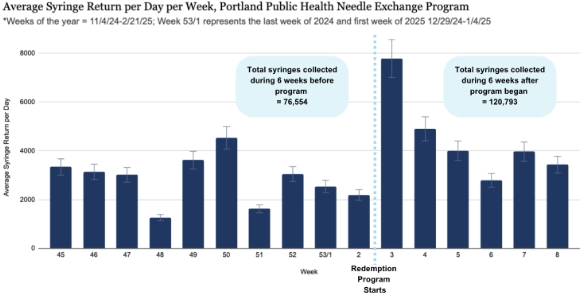
Rauscher indicated that 156 unique clients have been enrolled in the syringe redemption program, with a total of 38,252 needles collected between Jan. 14 and Feb. 21 and $3,852 paid out to those 152 participants.
A majority of the program participants are unhoused (48 percent) or have unstable housing (27 percent), Rauscher wrote.
A total of 76 participants returned syringes collected from the ground, and 42 participants returned more than 200 syringes, exceeding the program’s maximum weekly redemption amount.
The Portland Public Health director wrote that there has been a 76 percent reduction in the collection of improperly disposed of syringes by city staff from the six weeks before the program (1,677 needles) to the six weeks after (387 needles).
The City of Portland’s recently implemented “syringe buyback” program is showing signs of effectively increasing the number of syringes returned the city’s syringe exchange and of reducing the number of used needles littering the city, according to a city memo published this week.
Portland’s Syringe Services Program (SSP), commonly referred to as “The Exchange,” is part of a statewide “harm reduction” program overseen by the Maine CDC that distributes hypodermic needles to people who inject drugs.
Prior to the COVID-19 pandemic, the Maine CDC had rules in place that required SPP participants to exchange used needles for sterile syringes at a 1:1 ratio.
Current Maine CDC guidelines, however, allow for the syringe exchanges to distribute up to 100 needles for every one needle that they collect.
In fiscal year 2024, the city had just over 5,000 clients enrolled in their SSP, and distributed a total of 952,411 needles, while collecting 577,517 — a gap of roughly 375,000 syringes that were not returned to the exchange.
In October 2024, the Portland City Council voted 7-1 against restoring a 1:1 exchange ratio at the city’s SSP, instead opting to allocate roughly $1.38 million in opioid settlement funds towards three different public health initiatives related to the opioid crisis.
The first of the initiatives earmarked $52,000 for the year-long pilot “syringe buyback” program, modeled after similar programs implemented in Boston and New York City, and which would involve the city’s syringe exchange program paying drug users cash when they return used syringes.
The program officially launched on Jan. 14, and in the six weeks following implementation of the program, a total of 120,793 syringes were collected by the city, compared to 76,554 syringes during the six weeks before the program — a 52 percent increase — according to a memo from Portland Public Health Director Bridget Rauscher.
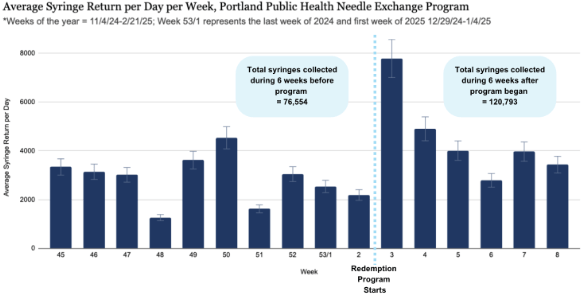
Rauscher indicated that 156 unique clients have been enrolled in the syringe redemption program, with a total of 38,252 needles collected between Jan. 14 and Feb. 21 and $3,852 paid out to those 152 participants.
A majority of the program participants are unhoused (48 percent) or have unstable housing (27 percent), Rauscher wrote.
A total of 76 participants returned syringes collected from the ground, and 42 participants returned more than 200 syringes, exceeding the program’s maximum weekly redemption amount.
The Portland Public Health director wrote that there has been a 76 percent reduction in the collection of improperly disposed of syringes by city staff from the six weeks before the program (1,677 needles) to the six weeks after (387 needles).
The memo will be presented to the City Council’s Health and Human Services and Public Safety Committee meeting on Tuesday, March 11.

0 Comments