In December, Maine saw an unemployment rate of 3.2 percent, representing little change from the previous month, according figures released by the Maine Department of Labor (MDOL).
Also largely consistent with November’s statistics was Maine’s workforce participation rate, which came in at 60.2 percent.
Labor force participation rates are representative of the proportion of working-age individuals who are either employed or actively searching for work.
Although there are a number of different ways to calculate the labor force participation rate, the MDOL arrives at its statistics by considering all individuals over the age of 16. Consequently, retirees and other elderly individuals are included in these numbers.
As a result, it can be more complicated to parse these statistics, particularly given Maine’s aging population.
Looking at states with a similar average age, however, suggests that there is likely more to the story in Maine than simply an older-than-average population.
While Maine, New Hampshire, and Vermont all have a similar median age, New Hampshire and Vermont have significantly higher rates of labor force participation this month – at 65.6 percent and 65 percent respectively.
That said, Maine’s labor force participation rate has risen marginally over the past year, albeit quite slowly, going from 59.3 percent in December 2023 to 60.2 percent in December 2024, representing just under a 1 percent increase.
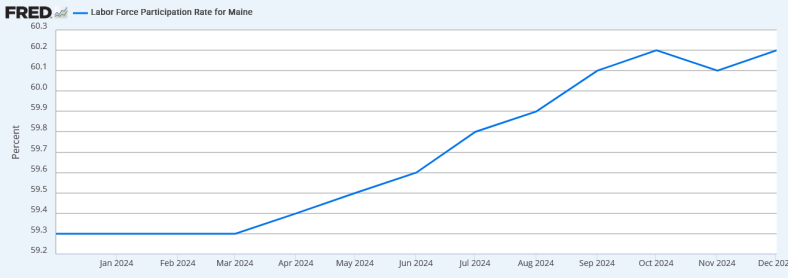
While summer lows and winter highs are expected for rates that are not seasonally adjusted, the MDOL explains seeing these these peaks and valleys for seasonally adjusted figures — as the state has had for the past two years — not as a “usual pattern” and is not something that “should be expected to persist” going forward.
Seasonal adjustment is a statistical technique that is used to remove the influences of “predictable seasonal patterns” in order to reveal a more accurate measure of how the employment situation has evolved over time.
The MDOL also cautions that, in general, monthly unemployment figures should be considered “in the context of whether they are below, near, or above” historical and nationwide averages, as opposed to how they compare from one month to the next.

Recently released data has also shed some light on the number of jobs available in the state and how they are being filled.
Maine had 34,000 job openings in December, up slightly from 33,000 in November, according to the national Bureau of Labor Statistics.
The ratio of unemployed people to job openings in the state was .7 in December, meaning that there were more jobs available than people out of work. This has been the case in Maine since January 2021.
Throughout the state, 25,000 people were hired in December, while 23,000 people were either fired or quit.

Of these 23,000 people who left their jobs, 13,000 were recorded as having quit while 9,000 were either laid off or fired.
Over the course of 2024, both hirings and separations respectively averaged at 26,000 per month. The number of people quitting their job averaged 14,000 and ranged from a minimum of 12,000 to a maximum of 18,000.
Rounding out the separations, the number of people who were either laid off or fired averaged 10,000 per month, ranging from 8,000 to 14,000 depending upon the month.




0 Comments