
Voter ID will officially be on the ballot this year in Maine, as the Secretary of State has now certified the petitions submitted as part of a grassroots effort to get this issue before the people of Maine.
Led by Dinner Table Action Executive Director Alex Titcomb and Rep. Laurel Libby (R-Auburn), the effort to get voter ID legislation on the ballot was accomplished with minimal funding and hundreds of volunteers.
The proposed legislation, if enacted, would require voters to present a photographic ID or otherwise prove their identity in order to cast their ballots.
4,410 petition forms were submitted to the Secretary of State’s Office with 171,562 signatures, far exceeding the required 67,682 needed, as well as the 100,000 goal set by the Voter ID for ME campaign.
Maine Secretary of State Shenna Bellows (D), a top critic of voter ID legislation, informed Titcomb on Wednesday that she wasn’t able to find enough signatures to disqualify the ballot initiative, in part because of the number the group had submitted.

As a result of this, the proposed voter ID legislation will appear on Mainers’ ballots this November.
If approved, Maine would become the 36th state to implement voter ID requirements, bringing the state into alignment with emerging trends in America and Europe.
Currently, 46 out of 47 European countries require some form of personal identification in order to vote.
While supporters of voter ID laws have argued that it’s a common sense measure, opponents have suggested that it represents a form of voter suppression.
Despite repeated allegations that voter ID would suppress the vote of minority and low-income citizens, a 2019 report from the non-partisan National Bureau of Economic Research (NEBR) argued that these claims are unsubstantiated.
“Using a difference-in-differences design on a 1.3-billion-observations panel, we find the laws have no negative effect on registration or turnout, overall or for any group defined by race, gender, age, or party affiliation,” the NEBR wrote. “These results hold through a large number of specifications and cannot be attributed to mobilization against the laws, measured by campaign contributions and self-reported political engagement.”
This report also noted that such requirements were not found to have any impact on fraud, “actual or perceived,” but this has not detracted from Americans’ overwhelming support for voter ID legislation.
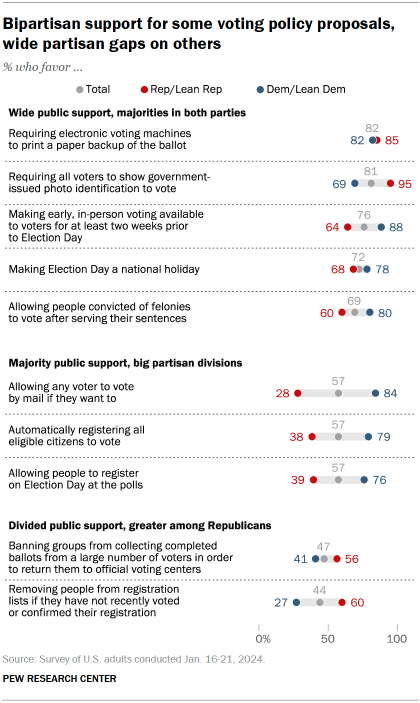
According to a February 2024 poll conducted by Pew Research Center, voter ID laws are supported by 81 percent of Americans.
This poll goes on to highlight the strong bipartisan nature of this support, with 95 percent of Republicans and 69 percent of Democrats expressing a desire for photographic identification to be required when casting a ballot.
Under the law that will appear on this November’s ballot, voters would be required to present a valid photo ID, such as a Maine driver’s license, U.S. passport, or military ID, when casting their ballots in person.
Voters without photo identification would be able to cast a challenged or provisional ballot with the caveat that they must provide proper ID within four days post-election for their vote to be counted.
Religious exemptions for those will moral objections to being photographed can be obtained through an affidavit process. Voters with objections to photography must submit an affidavit citing their beliefs and provide the last four digits of their Social Security number for verification.
To minimize financial barriers, the legislation requires the state to issue free nondriver identification cards to eligible residents without a Maine driver’s license.
This law, if passed, would go into effect on January 1, 2026, providing some time for any necessary infrastructure adjustments to made, as well as for the launch public awareness campaigns.
Under this timeline, voter ID would be in place for the November 2026 elections, which are expected to be consequential for Maine.
Not only will the gubernatorial election be an open race, but U.S. Sen. Susan Collins (R) will be seeking re-election. U.S. Rep. Jared Golden (D) could also potentially vacate Maine’s Second Congressional District office in order to run for governor, leaving the contest for that seat open as well.
Click Here to Read the Full Text of the Proposed Voter ID Law



0 Comments