Maine Gov. Janet Mills (D) and her finance commissioner have remained silent in the face of bipartisan condemnation of the administration for withholding information from lawmakers.
The controversy over the Mills Administration’s closed-door governance spilled into the public when the deputy director of Maine’s Department of Administrative and Financial Services (DAFS) admitted to illegally withholding documents from lawmakers during a Jan. 16 meeting of the Veterans and Legal Affairs (VLA) Committee.
Despite the outcry—and even belated coverage from media outlets other than the Maine Wire—Gov. Mills and DAFS Commissioner Kirsten Figueroa haven’t commented publicly on a scandal that continues to raise questions about the administration’s secrecy and poor record handling of Freedom of Access Act requests.
DAFS Deputy Director Anya Trundy, who serves as a liaison between the massive state agency, lawmakers, and the public, confessed to withholding reports about Maine’s legal cannabis markets — reports that she was required under state law to share.
Pressed by the House Republican lead on VLA, Rep. David Boyer (R-Poland), Trundy admitted that the 2023 reports for Maine’s adult-use cannabis industry and the medical cannabis program were never given to lawmakers or the public because Trundy felt personally that it would be best to keep those reports secret.
“We had a really difficult legislative session last year in this committee that was filled with a lot of acrimony, and that report is due in the middle of it,” said Trundy. “And when the draft came to me from OCP, I put it on my desk and I realized that it needed some editing, and that likely releasing that report would throw another log on the fire. And I didn’t want to throw another log on the fire.”
“What I really wanted to do was have a tone change, and at the end of the session, we ended on a great note,” she said.
Rep. Boyer immediately condemned Trundy’s unilateral decision to keep lawmakers in the dark in a radio interview following the committee hearing.
House Minority Leader Billy Bob Faulkingham (R-Winter Harbor) soon joined Boyer’s call for greater transparency from the Mills Administration, as did the two Democratic co-chairs of the VLA Committee, which oversees Maine’s Office of Cannabis Policy (OCP).
“While I understand the challenges of legislative negotiations, it is deeply concerning that an official with such a high level of responsibility would take actions that circumvent the law and undermine transparency in government processes,” Faulkingham said in a Jan. 23 letter to DAFS Commissioner Kirsten Figueroa.
“House Republicans ask that you clarify whether you were aware of this action and, if so, your stance on the matter,” Faulkingham said. “Additionally, I am eager to understand what steps you plan to take to address this violation and ensure that employees within your department uphold their legal and ethical obligations. Restoring the trust between lawmakers, your department, and the public is essential, and I believe addressing this issue is an important first step toward that goal.”
Sen. Craig Hickman (D-Kennebec) and Rep. Lauren Supica (D-Bangor), the VLA co-chairs, penned a Jan. 22 letter of their own to OCP Director John Hudak, reminding him of the statutory obligation to turn over the reports.
In their letter, Hickman and Supica requested that DAFS and OCP immediately comply with the law and turn over not only the final version of the reports—originally due on Feb. 15, 2024—but also any earlier drafts of the reports, which Trundy referred to in her original testimony.
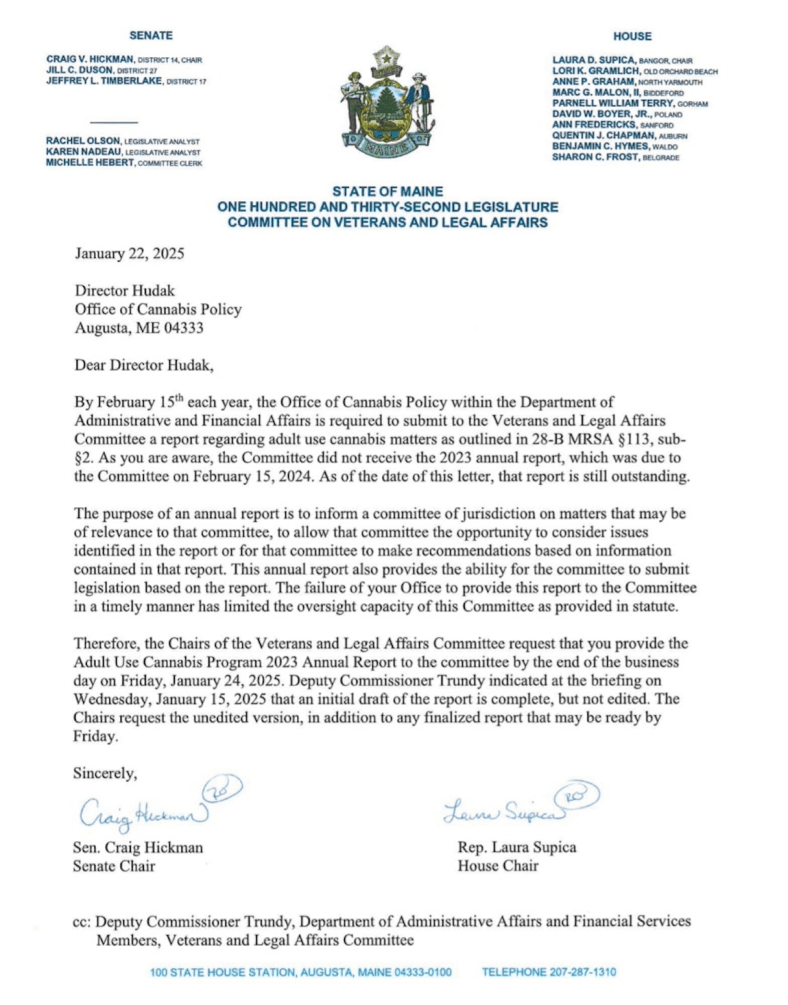
“The failure of your Office to provide this report to the Committee in a timely manner has limited the oversight capacity of this Committee as provided in statute,” the co-chairs said.
Although Trundy has ignored the Maine Wire’s inquiries regarding her comments, a DAFS representative did communicate about the matter with the “Maine Trust for Local News” — OCP’s preferred venue for sharing information and disclosures favorable to the agency’s interests.
In a January 24 letter to Hickman and Supica, Trundy apologized for keeping lawmakers in the dark but offered a lengthy defense of her decision. She also made clear that Figueroa had no involvement in the decision to withhold the reports, though she made no mention of Hudak, who would undoubtedly have been aware that the reports were not turned over as required by statute.
“I also want to be clear that my decision was mine alone, and that Commissioner Figueroa was not made aware of my decision at the time,” Trundy wrote.
Although the 2023 reports Trundy concealed from lawmakers have been handed over to VLA committee members, they are still absent from the OCP website where reports from previous years are currently available.
Those reports are not the only government records that Trundy is responsible for transmitting to lawmakers — or the public.
Trundy also had a hand in processing Freedom of Access Act (FOAA) requests submitted by members of the public and journalists, including the Maine Wire.
Since 2022, DAFS has been among the least responsive of all government agencies, routinely failing to provide time and cost estimates for public record requests from this outlet, often for more than 600 days.
Unlike like many government agencies, successfully obtaining public records from DAFS requires sending the agency multiple reminders and, typically, threatening legal action.
The agency also has a habit of losing track of FOAA requests and needing reminders about when requests were submitted and what the requests entailed.
For example, The Maine Wire submitted a FOAA request to DAFS on Feb. 26, 2024, for records related to an illegal marijuana operation that was causing trouble for a small town in northern Maine.
DAFS never addressed the request until Dec. 2024—nine months later—in an email indicating that they had just begun the process of responding to the request, which currently remains unfulfilled.
The request, submitted at the same time Trundy would have been illegally withholding records from lawmakers, may have been yet another “log” the bureaucrat unilaterally decided not to throw on the fire, as it might have inconvenienced the agency’s legislative agenda.
It’s unclear what role, if any, Trundy will continue to have in mitigating journalists’ access to OCP records or the records held by DAFS and its various sub-agencies.
Senate Minority Leader Trey Stewart (R-Aroostook) excoriated Trundy, DAFS, Figueroa, and Gov. Mills in a statement Monday, raising further questions about the Mills Administration’s trustworthiness and general lack of transparency.
“It is appalling that a statutorily required report to the Legislature’s Veterans and Legal Affairs committee was intentionally withheld for nearly a year,” said Stewart.
“This occurrence begs two questions of the Governor,” Stewart said. “First, ‘What did the Governor know and when?’ Second, ‘How many other executive branch employees are trying to pull one over on us?’ I look forward to hearing the Governor address this unacceptable breach of trust.”
As of this report, neither Mills nor Figueroa has commented publicly on the apparent culture of secrecy the imbroglio has revealed.
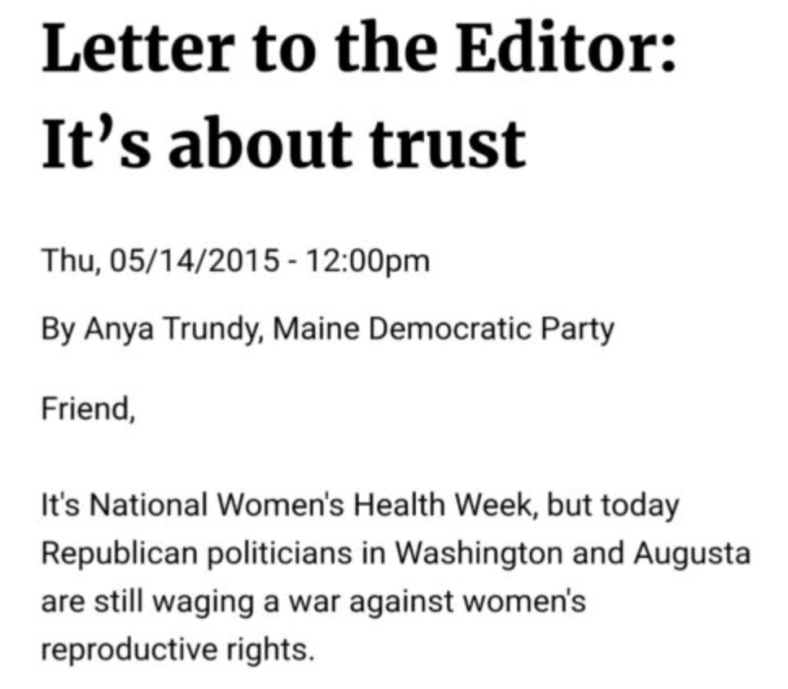
Trundy, whose taxpayer-funded compensation totaled more than $150k in 2024, has also been an official in the Maine Democratic Party in the past, once writing a letter to the editor titled, “It’s About Trust.”

0 Comments