
The superintendent of Lewiston Public Schools issued an announcement on Thursday on the “real fear” among the school community regarding the potential for U.S. Immigrations and Customs Enforcement (ICE) to make arrests on school grounds, advising families on their constitutional rights and recommending that they seek advice from a lawyer before being detained.
Superintendent K. Jake Langlais sent out the letter just days after President Donald Trump took office and signed a series of executive orders and policy directives aimed at cracking down on illegal immigration, including a move that will allow federal immigration agencies to make arrests at schools, churches and hospitals.
“There have been many questions this week about changes in language for Immigration and Customs Enforcement known as ICE,” Langlais wrote in the announcement, addressed to “Whom It May Concern.”
“We wanted to reach out to share some of our experiences and some information some families may find useful,” he wrote.
On Monday, Acting Department of Homeland Security (DHS) Secretary Benjamin Huffman issued a directive to ICE and Customs and Border Protection (CBP) that will allow the federal agencies to carry out immigration enforcement in so-called “sensitive locations,” including schools.
“This action empowers the brave men and women in CBP and ICE to enforce our immigration laws and catch criminal aliens — including murderers and rapists — who have illegally come into our country. Criminals will no longer be able to hide in America’s schools and churches to avoid arrest,” the DHS said in a statement Tuesday announcing the directive.
The directive reverses guidance that had been in place for over a decade that has restricted ICE and CBP from carrying out enforcement operations in those locations.
Superintendent Langlais wrote that in past interactions with ICE, the enforcement has been “specific to an individual and has been carried out with all the appropriate documentation and steps.”
“We have not had any interactions administratively that were carried out in any way outside of known protocols,” Langlais wrote.
Langlais said the district has reminded school leaders about the protocols to follow if law enforcement shows up at a Lewiston school and reaffirmed the district’s commitment to student privacy.
“Student information at schools is highly protected by established privacy rights. We will follow these laws,” he wrote.
“There are many beliefs about some members of our community and assumptions about papers, status, etc.,” the superintendent continued. “We want to be clear – to our knowledge, the families of our school community have gone through various immigration processes that are thorough.”
Despite his apparent confidence in the legal immigration status of Lewiston Public Schools’ community members, Langlais then proceeded to share tips regarding how to avoid being detained by ICE, what do to if you are detained by federal agents, and advised the community to consult an attorney in advance of potential detainment.
“There is a real fear among many due to a sense of the unknown,” Langlais wrote. “We are sharing some tips that have been shared with us in the hopes they can help ease some of the stress being experienced.”
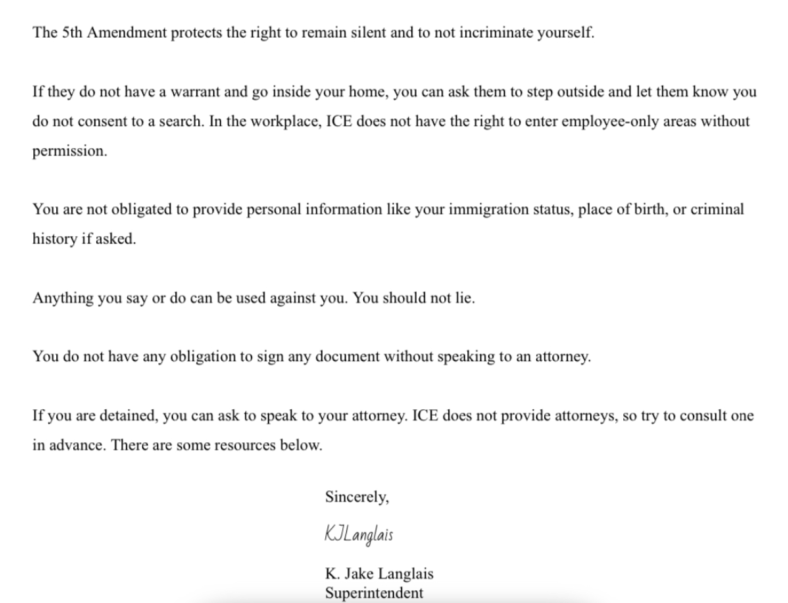
The superintendent began his “tips” with a list of rights individuals have in interactions with law enforcement, such as the right to remain silent, the right to say you do not consent to a search, and that ICE does not have the right to enter your home without a valid warrant signed by a judge.
Langlais also said that in the workplace, presumably in this case referring to schools, “ICE does not have the right to enter employee-only areas without permission.”
“You are not obligated to provide personal information like your immigration status, place of birth, or criminal history if asked,” he wrote. “Anything you say or do can be used against you. You should not lie.”
“You do not have any obligation to sign any document without speaking to an attorney,” he wrote.
Offering a last piece of advice, Langlais said that if you are detained by ICE, you can ask to speak to your attorney.
“ICE does not provide attorneys, so try to consult on in advance,” he added, including links to a list of free legal aid clinics in Maine and the Portland-based Immigrant Legal Advocacy Project (ILAP) nonprofit.
The full letter from Lewiston Superintendent K. Jake Langlais can be read below:




0 Comments