
The New England Fishermen’s Stewardship Association (NEFSA) will be sending Gov. Janet Mills a petition with over 2,500 signatures urging her to halt the development of offshore wind farms in the Gulf of Maine, according to a source close to the matter.
NEFSA is a bipartisan nonprofit organization dedicated to helping save the region’s commercial fishing industry and preserving it for future generations.
Signatories on the petition include commercial fishermen, as well as residents of New England maritime communities.
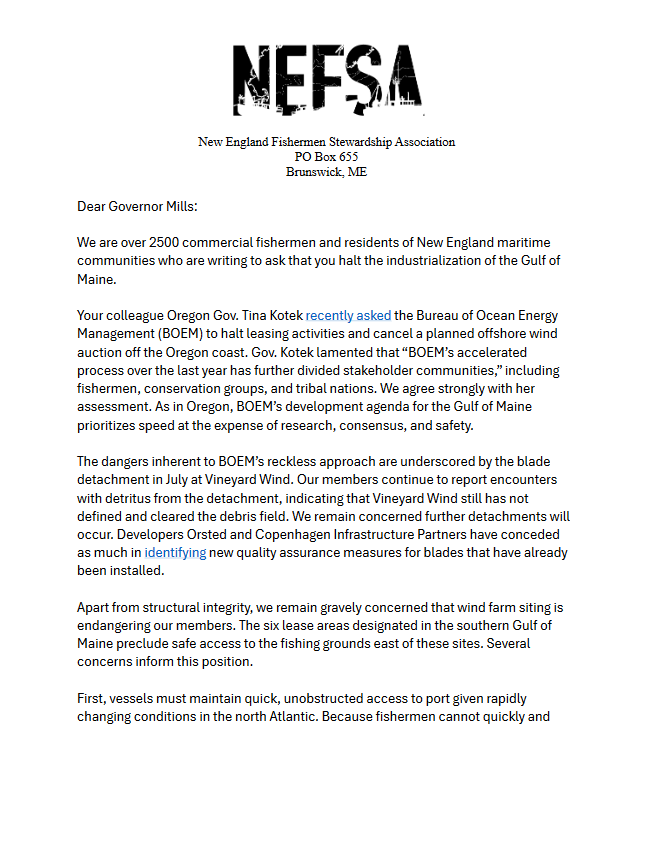
In a copy of the petition’s letter obtained by the Maine Wire, NEFSA CEO Jerry Leeman urged Gov. Mills to follow in the footsteps of Oregon Gov. Tina Kotek (D) by asking the Bureau of Ocean Management (BOEM) to halt its efforts to lease property off the coast.
When making this request, Gov. Kotek cited a need for the state to better understand the benefits and risks associated with these emerging technologies before moving forward with further leasing.
“As in Oregon, BOEM’s development agenda for the Gulf of Maine prioritizes speed at the expense of research, consensus, and safety,” wrote NEFSA.
“The dangers inherent to BOEM’s reckless approach are underscored by the blade detachment in July at Vineyard Wind,” the organization continued.
Vineyard Wind US — a joint venture of Central Maine Power (CMP) parent company Avangrid and Copenhagen Infrastructure Partners — came under heightened scrutiny after one of its wind turbines was significantly damaged over the summer, causing a blade the size of a football field to break apart into the water.
According to NEFSA, members have continued to report encounters with debris from the detachment, noting the possibility that further detachment may occur in the future.
“Developers Orsted and Copenhagen Infrastructure Partners have conceded as much in identifying new quality assurance measures for blades that have already been installed,” they said.
NEFSA’s letter goes on to raise concerns about the location of lease areas, explaining that “the six lease areas designated in the southern Gulf of Maine preclude safe access to the fishing grounds east of these sites.”
“Because fishermen cannot quickly and safely transit through wind farms, mariners will be forced to follow long detours around energy sites, an unwelcome prospect during an emergency,” Leeman wrote.
In a footnote, Leeman explains that NEFSA believes the designation of “safe-transit vectors” in or between wind farms is “inadequate” because “for reasons not yet understood,” wind farms interfere with marine radar.
“Fishermen are thus reluctant to approach wind farms with any regularity,” he wrote. “Nor can safe transit be assured during adverse weather conditions. No fishermen would approach a wind farm during a high swell.”
Leeman also notes concerns over potential radar malfunctions in the main text of his letter to Mills, suggesting that “ongoing interference — if not outright navigation failure — over a large swath of ocean strongly counsels against approaching the southern lease sites.”
“Given these well-grounded concerns, we ask that you follow Gov. Kotek’s example and ask BOEM to suspend offshore wind lease auctions for the Gulf of Maine,” he wrote.
“We are proud to do our part to maintain resilient fisheries,” NEFSA concluded. “Our livelihoods and the future of our historic communities depend on our prudent stewardship. We hope you will join us in protecting Maine’s historic fisheries.”
According to the University of Maryland Center for Environmental Science, “there are some concerns about the environmental impacts of wind turbines.”
For example, birds and bats are at risk of death from colliding with rotors, as well as from the pressure effects of vortices. There is also a chance of displacement due to changes in migration routes and a “loss of quality habitat.”
The Center also outlines a number of ways in which wind farms can negatively impact marine life, particularly with respect to the noise and vibrations created by the construction and operation of the turbines.
The federal National Oceanic and Atmospheric Administration (NOAA) acknowledges the same concerns raised by NEFSA in their letter to Mills, including the disruption of vessels’ radar systems and reduced safety as a result of increased traffic and navigation challenges.
NOAA explains on its website that they “provide data and information” to BOEM regarding “historic fishing operations and coastal communities’ reliance on fishing operations,” as well as the potential impacts of offshore wind “on the commercial and for-hire fishing industries.”
New England for Offshore Wind — a coalition comprised on numerous groups including Maine Climate Action Now! (MCAN), Maine Labor Climate Council, and Maine Youth for Climate Justice — suggests that offshore wind could be a “game-changer” for New England’s power grid.
The coalition says that New England could see “tremendous environmental benefits” from “responsibly” developed offshore wind that incorporates “wildlife monitoring and mitigation,” including reduced carbon dioxide emissions and improved air quality.
They also highlight some projected economic benefits associated with offshore wind, noting that the American Wind Energy Association (AWEA) estimates the industry would bring 83,000 jobs and $25 billion per year in economic output by 2030.
The federal Department of Energy (DOE) refers to wind as a “clean and renewable energy source” — currently helping to eliminate 336 million metric tons of carbon dioxide emissions annually — that is both “cost effective” and “benefits local communities.”
Despite underscoring these expected advantages, however, the DOE also notes that wind farms “produce noise and alter visual aesthetics,” as well as “impact local wildlife,” noting that “research is still needed to minimize wind-wildlife interactions.”
It was announced in August of this year that State of Maine reached an agreement with BOEM regarding a floating offshore wind research lease in the Gulf of Maine.
The lease covers an area of up to 15 square miles of federal waters located nearly 30 miles southeast of Portland and will be the site of the nation’s first floating offshore wind research array.
The array will include as many as twelve floating turbines and inform how floating offshore wind operates and can co-exist with ocean users and ecosystems in the Gulf of Maine, according to the projects supporters.
Construction on the array is not likely to take place for several years as a Research Activities Plan must first be submitted to BOEM for environmental analysis under the National Environmental Policy Act.
Additional details on the timing of construction are expected to become clearer as the permitting process progresses.


0 Comments