A Democratic State Representative published an op-ed bragging about the 2023-2024, Democrat-led state spending spree just hours before the Mills Administration quietly disclosed that the State of Maine is projecting a nearly one billion dollar funding shortfall for 2026-2027.
Without any Republican support or votes, Democrats created, approved, and signed into law the most recent two-year spending package, Rep. Drew Gattine (D-Westbrook) bragged.
What Gattine didn’t know when he was writing the post — or what he declined to acknowledge — is that Maine’s top budget officer now says the State must confront a $949.2 million “structural gap” for the next budget writing session.
“Democrats in the Legislature passed a two-year state budget with hundreds of millions of dollars in funding for municipal revenue sharing, K-12 public schools, free breakfast and lunch for students and salary supplements for early childhood educators,” Gattine said.
“[Rep. Laurel] Libby and her Republican colleagues brag about not voting for the budget,” Gattine said.
Just hours after Gattine attempted to take a victory lap for spending hundreds of millions of taxpayer dollars on left-wing pet projects, the Mills Administration quietly admitted that the state doesn’t even have the money to fund those projects.
In a terse letter to Gov. Mills and legislative leaders, Department of Administrative and Financial Services Commissioner Kirsten Figueroa disclosed what she referred to as a “structural gap.”
The $949.2 million shortfall includes a $636.7 million projected deficit in the General Fund and a Highway Fund gap of $312.5 million for the 2026-2027 biennium.
Those numbers come from the most recent four-year budget forecast report released by DAFS Acting State Budget Officer, Darryl Stewart.
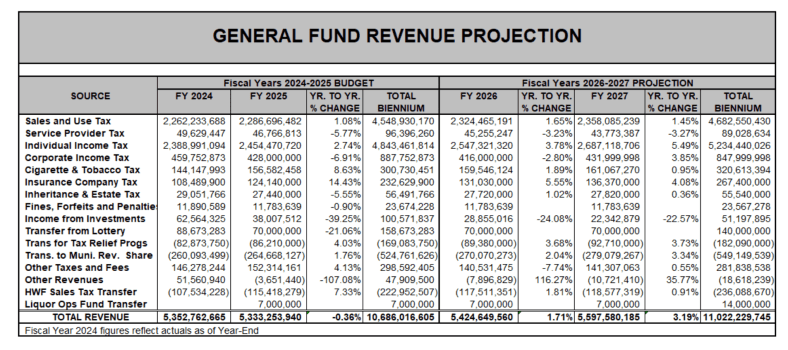
According to Stewart’s forecast, general fund revenue is projected to grow during the next biennium by more than $336,000,000.
However, even that surge in government revenue won’t be enough to cover the spending spree Gattine and his Democratic colleagues continue to tout to voters.
In other words, the crisis-level deficit is being driven primarily by overspending rather than a lack of revenue.
“The final result – often called the structural gap – is the amount of money by which revenues would have to increase, expenses would have to decrease, existing laws would have to be amended, or some combination thereof would have to be achieved in order for revenues to meet expenditures, as identified by law,” Figueroa said.
Because Maine’s state constitution requires the passage of a balanced budget, the next legislature is going to have significant work to do to clean up the financial situation left behind by the 131st Legislature.
That work will include, at a minimum, repealing and reversing nearly $1 billion of the Democratic spending bonanza Gattine touted — or raising taxes massively in an attempt to come up with new revenues.
Here’s a screenshot of Gattine’s op-ed for posterity’s sake.




0 Comments