Maine’s Right to Know Advisory Committee (RTKAC) — a government body designed to advise on government transparency and public record requests — has concluded its review of “burdensome” uses of Maine’s Freedom of Access Act (FOAA).
Although the investigation began as an attempt to identify ways in which Maine’s government transparency law was being abused, the findings of the investigation show very few instances of what the committee described as “burdensome” requests.
Earlier this year, the RTKAC — in conjunction with the Maine Municipal Association (MMA) — distributed surveys to local governments and state agencies in order to gather examples of “burdensome public records requests” and what the committee described as potential abuses of Maine’s Freedom of Access Act (FOAA).
While the vast majority of those contacted had no concerns to report, a few organizations shared their negative experiences related to FOAA requests. The MMA — a nonprofit representing Maine’s cities and towns — aggregated responses from a number of municipalities throughout the state.
FOAA is a government transparency law designed to ensure that Mainers have a “broad right of access to public records” while simultaneously “protecting legitimate governmental interests and the privacy rights of individual citizens.”
This law also guarantees that citizens have access to “meetings of public bodies” in the interest of improving government accountability.
The RTKAC was statutorily established in 2005 “to serve as a resource for ensuring compliance with [FOAA] and upholding the integrity of the purposes underlying this [law] as it applies to all public entities in the conduct of the public’s business.”
More recently, the RTKAC has seemed focused on limiting public access to certain records and reducing the burden on government employees that is associated with producing records for inquiring taxpayers or journalists.
A memo issued by the Office of Policy and Legal Analysis (OPLA) to the RTKAC last week explained that surveys were distributed, as requested, to “state agency FOAA contacts,” as well as a number of organizations such as the Maine School Management Association (MSMA) and the MMA.
Surveys were also sent directly to the Maine County Commissioner’s Association, the Maine Town and City Manager Association, and the Maine Town and City Clerks’ Association.
Click Here to Read the RTKAC’s Full Memo
Although more than fifteen responses to this survey were received, the RTKAC memo stated that twelve entities “did not have any unresolved examples or suggestions to share.”
In addition to this, however, the MMA aggregated responses from nearly 25 municipalities located throughout the state, many of whom raised a handful of concerns over various types of FOAA requests, such as those which are unreasonably broad or represent “fishing” expeditions by commercial entities.
Several towns also pointed out apparent attempts to find loopholes in the FOAA process so as to avoid paying fees or to deliberately tie up local resources.
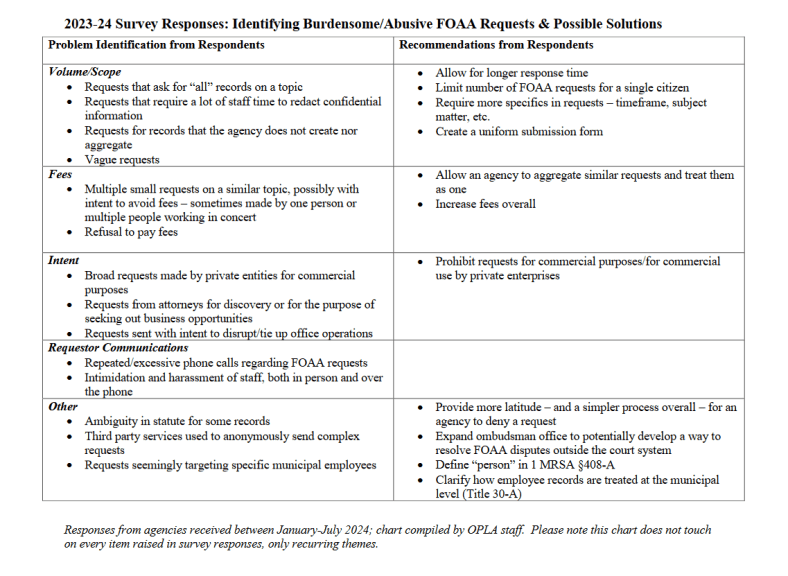
The OPLA memo summed up several “recurring themes” across all the survey responses received, as well as the recommendations proffered in response to these concerns.
With respect to the volume or scope of FOAA requests, survey respondents highlighted concerns over those which ask for “all” records on a particular subject without defining the terms of their search, as well as those which are simply too “vague.”
Requests for records requiring a significant amount of redaction were also underscored by those who responded to RTKAC’s survey as “burdensome.”
To address these concerns, respondents suggested allowing for longer response times, limiting the number of FOAA requests any one individual can submit, and requiring requests to include specifics such as its time frame and subject matter.
Another category of concerns gathered by OPLA focused on the intent of those making FOAA requests, encompassing issues such as “broad requests made by private entities for commercial purposes” and those sent with the “intent to disrupt/tie up office operations.”
Others reported receiving “repeated/excessive” phone calls regarding FOAA requests and experiencing “intimidation and harassment” both in person and over the phone.
Among the agencies reporting no concerns over burdensome or potentially abusive FOAA requests were the Department of Economic and Community Development (DECD), the Department of Defense, Veterans, and Emergency Management, the Maine Department of Labor (MDOL), the Maine Ethics Commission, and the Maine Human Rights Commission, among others.
Click Here to Read the Full Survey Responses
Concerns have, however, also been raised by those on the other side of this process, particularly members of the media who have encountered difficulty when attempting to retrieve information via FOAA requests for their reporting.
For example, WGME reported in May of this year that the Governors’ Office was seeking more than $1,400 worth of fees from the CBS13 I-Team in order to access public documents related to Gov. Janet Mills’ (D) recent out-of-state travel.
Justin Silverman of the New England First Amendment Coalition told WGME at the time that while the government is permitted to charge such substantial sums for access to public records, they “shouldn’t be” doing so.
“This information is of great public interest. It sheds a light on where the governor is going, how much money is being spent on these trips, whether these trips will even benefit the state of Maine,” Silverman explained.
In July, the Maine Wire filed a lawsuit against the Mills Administration after her office had neglected for 195 days to fulfill a FOAA request for information regarding her whereabouts during the December 2023 power outages despite being told it would only take a couple of weeks.
Shortly after the lawsuit was filed, the Mills Administration turned over highly redacted versions of the documents which showed a partial list of her publicly scheduled events.



0 Comments