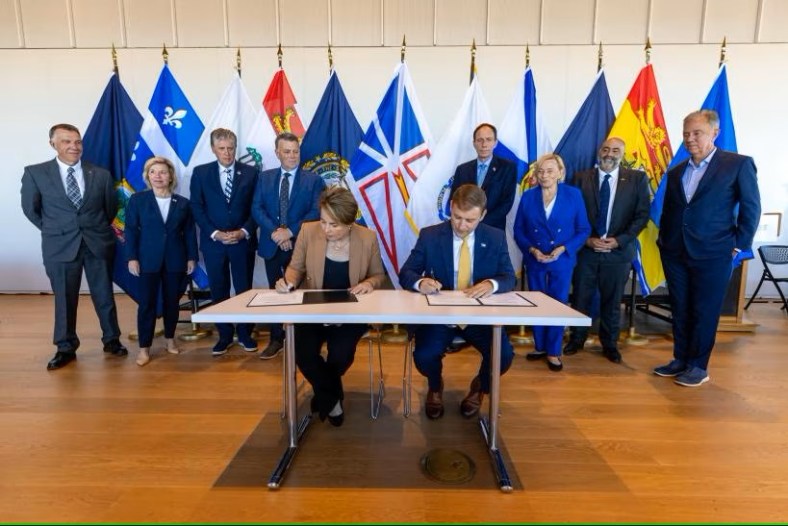
On Monday and Tuesday, Gov. Janet Mills (D) attended the 45th Annual Conference of New England Governors and Eastern Canadian Premiers (NEG-ECP) in Boston, MA which this year focused on “the clean energy transition.”
This conference, first launched in 1973, was designed to allow leaders from across the region — including from six states and five Eastern Canadian provinces — to work cooperatively on addressing their shared interests.
Members of the coalition include Connecticut, Maine, Massachusetts, New Hampshire, Rhode Island, Vermont, New Brunswick, Newfoundland and Labrador, Nova Scotia, Prince Edward Island, and Québec.
According to a press release from Gov. Maura Healey (D) of Massachusetts, this year’s conference centered primarily on clean energy “with a focus on achieving broad regional economic and reliability benefits, energy independence, and job growth.”
Gov. Healey goes on to explain that two “formal discussions” were held on developing a “regional offshore wind supply chain,” as well as “strategies for hard-to-decarbonize sectors.”
As a result of these discussions, the governors and premiers signed two resolutions designed to reconvene the Northeast International Committee on Energy (NICE) in order to pursue “regional collaboration and planning” on a variety of energy-related issues, as well as to direct the the Committee on Environment to reconvene and “consider further steps on ecological connectivity, climate adaptation and food security.”
“These two standing committees of the NEG-ECP have long served as vehicles for pursuing initiatives that the Governors and Premiers direct at the annual conference,” Healey’s press release said.
On Monday, the leaders visited the Massachusetts Maritime Academy to experience the Mærsk Mc-Kinney Møller Bridge Simulator and tour a “cutting-edge facility training the workforce for maritime fields, including the offshore wind industry.”
The group spent Tuesday at the Boston University Center for Data and Computing Science for a “series of roundtables” focused on “offshore wind supply chain and addressing hard-to-decarbonize sectors.”
“Maine has a long and productive history of working closely with our neighboring Canadian provinces and fellow New England states on a variety of shared issues, from our economies to our environment,” said Gov. Mills in a statement Tuesday. “I am proud to continue that longstanding tradition of cross-border collaboration through this year’s NEG-ECP Conference.”
“Through these regional partnerships, we will advance our shared vision of harnessing clean, renewable energy to enhance our energy independence, improve affordability, and create strong, good-paying jobs in rewarding careers – all of which will have the tremendous benefit of strengthening our economy and battling the climate crisis,” Mills said.
“Last year’s conference was an important milestone in the long-standing collaboration between our regions, marking the 50th anniversary of these cross-border meetings,” said Gov. Healey in a press release.
“We were proud to welcome our colleagues to Massachusetts to spark the beginning of our next 50 years of cooperative work together,” Healey continued. “We’re excited to continue our work together to achieve greater energy independence and affordability, create new union jobs and build up the climate workforce, and take proactive steps to address climate change.”
Click Here to Read Gov. Maura Healey’s Full Press Release
The Mills Administration has focused heavily on addressing environmental concerns, pushing for the rapid acceleration of heat pump installations and has accepted millions in federal funding for a variety of climate and clean energy related initiatives.
For example, Maine was recently awarded $147 million by the federal government o construct a multi-day energy storage system in Lincoln that it says will “enhance grid resilience and optimize the delivery of renewable energy.”
Located at the site of the former Lincoln Mill, this facility will be the first of its kind in New England and represents the “largest long-duration energy storage project” worldwide to date.
Although iron-air batteries are not yet broadly available in commercial markets, the technology has shown promise as a more cost-effective grid-scale battery than other, more common lithium-based batteries.
These funds will also be used to “strengthen the transmission system to support the delivery of higher loads of power from renewables, including nearby onshore wind turbines.”
Expanding heat pump usage has been a focus of the Mills Administration since 2019 when the governor signed legislation formally establishing a statewide goal of installing 100,000 heat pumps by 2025.
Last year, Mills announced that Maine had met this goal two years ahead of schedule. In response, she set forth a new goal of installing an additional 175,000 heat pumps by 2027.
Shortly thereafter, the United States Climate Alliance — of which Mills is a co-chair — expressed a commitment to increasing heat pump usage nationwide four-fold by 2030.
In February of this year, Maine politicians announced that the state had been awarded $10 million in federal taxpayer funding to to subsidize the installation of heat pumps in mobile and manufactured homes throughout the state.
Through this funding, Maine will install approximately 675 heat pumps in manufactured and mobile homes owned by low-income residents living in towns with populations less than 10,000.
Several months later, Maine received part of a $450 million federal grant designed to “accelerate the adoption of heat pump technology” in homes across the state.
Five New England states — including Maine, Connecticut, Massachusetts, New Hampshire, and Rhode Island — were given a combined total of $450 million in federal funding for the joint New England Heat Pump Accelerator project.
The New England Heat Pump Accelerator project aims to “leverage the power of a multi-state market to rapidly accelerate the adoption” of various heat pump technologies in single-family homes and other residential buildings in the region.
The goal of this project is to install nearly 580,000 heat pumps throughout New England, covering 65 percent of “residential-scale” heating and cooling sales by 2030 and 90 percent by 2040.


0 Comments