
Following a surge in the amount of money spent under the municipal welfare program known as General Assistance, the Mills Administration is seeking to establish an online database to better manage welfare applicants and recipients.
General Assistance is a welfare program through which municipalities provide low-income or indigent individuals and families — regardless of citizenship or immigration status — with vouchers to pay for housing, food, utilities and other basic necessities.
While the program is administered by municipalities, the state is required by law to reimburse those municipalities for 70 percent of their General Assistance spending.
According to a Request for Proposals (RFP) document published Thursday, the Maine Department of Health and Human Services (DHHS) has begun seeking applications from technology platforms to assist the state in digitizing the General Assistance welfare program.
In fiscal year (FY) 2023, a total of $42.9 million in General Assistance benefits was spent by municipalities statewide, up from just $12.7 million in FY 2019, the RFP states.
Of the more than $40 million spent on the welfare program by Maine cities and towns in FY 2023, $30 million was reimbursed by state taxpayers.
Currently, Maine’s largest cities do not keep track of the citizenship or immigration status of those who receive General Assistance benefits, meaning there’s no way to assess what percentage of total welfare spending is flowing to asylum seekers, illegal aliens, or other classes of non-citizens.
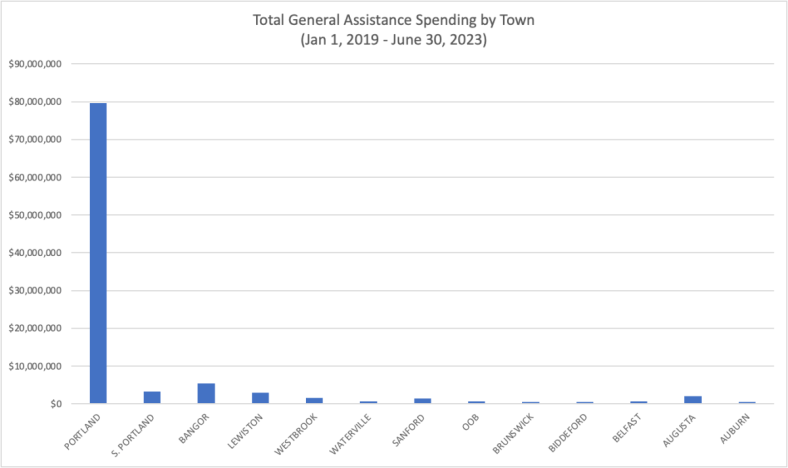
A previous investigation by the Maine Wire found that Maine’s General Assistance spending has been driven almost entirely by the city of Portland, which spends 50 times more per person under the welfare program and accounts for more than 70 percent of all General Assistance spending in the state.
Despite the tens of millions of taxpayer dollars spent on the welfare program, the Mills Administration admits in the RFP that they currently do not have an accurate count of the total number of individuals receiving General Assistance benefits in any given year, nor do they know the amount of money spent on each individual.
Maine DHHS attributes this deficiency in oversight to “data limitations and lack of a comprehensive State-wide database.”
Through the RFP, the Mills Administration will be soliciting bids from contractors to build a digital platform to manage General Assistance applicant data, budget and benefits calculations and voucher expenditure and reimbursement.
The contractor will also be tasked with creating an online public-facing portal for Maine residents to apply for General Assistance benefits.
Proposals from contractors are due by early October, and the Mills administration is looking to begin development of the online database and platform by April 2025.



0 Comments