
Maine has the seventeenth most underprivileged children nationwide with the sixth worst health, according to a recent study by WalletHub.
All fifty states plus Washington D.C. were scored across several variables related to children’s well-being, including socioeconomic welfare, health, and education.
Although Maine fell more towards the middle of the pack with respect to socioeconomic welfare and education — coming in twentieth and twenty-ninth respectively — children in Maine were found to be in the sixth worst conditions with respect to their health.
Factored into each state’s health score were the percent of maltreated children, share of teenagers who reported feeling sad or hopeless in the past year, the child food insecurity rate, infant mortality rate, and child death rate, among others.
Of these factors, Maine was notably found to have the fourth highest percentage of maltreated children, led only by Iowa, West Virginia, and Massachusetts.
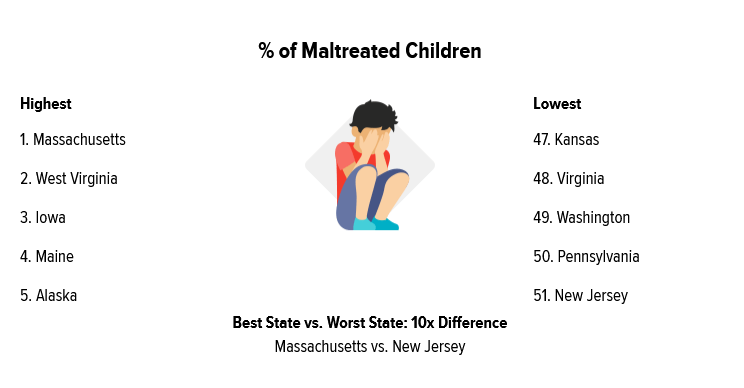
It was also found that Maine has the fifth highest share of children in foster care. West Virginia, Alaska, and Montana all tied for first, with Kansas falling into fourth place.

Click Here to Read the Full Results of the Study
Maine’s Office of Child and Family Services (OCFS) has come under great scrutiny in recent years for its repeated failure to protect the state’s most vulnerable children.
At the end of last year, Walk a Mile in Their Shoes (WAMITS) — a non-profit founded by former Democratic state senator Bill Diamond — released an extensive report detailing the shortcomings of Maine’s Department of Health and Human Services (DHHS) and what could be done about it.
This report was the culmination of a series of listening sessions held throughout the state with those know first hand what’s happening on the ground in these situations — including “current and former caseworkers, foster parents, childcare providers, educators, law enforcement officials, and others who interact with DHHS on a regular basis.”
Each section outlined the “areas of concern” that were noted by stakeholders, explained the consequences that are associated with these problems, and concluded with a number of practical and realistic solutions aimed at solving the identified issues.
Among the issues noted in this report were insufficient training, a “dysfunctional” computer system, unrealistic expectations, unmanageable caseloads, and a lack of support for foster families, among other things.
Similar issues were also revealed by a series of public records obtained by the Maine Wire last year.
The Child Welfare Ombudsman’s 2023 Annual Report also detailed these continued failures and offered recommendations of its own for improvement.
“As has been true in previous annual reports, this year shows continued struggles with decision-making around child safety,” the report stated. “Primarily, the Department has had difficulty in two areas: 1) during initial investigations into child safety and decision-making around where a child is safe during an investigation, and 2) during reunification when making safety decisions about whether to send a child home.”
The report then went into greater detail concerning the shortcomings of DHHS and OCFS as identified by the dozens of case-specific reviews conducted by the Ombudsman throughout the year.
“In order to make safety decisions correctly during an investigation, 1) enough facts and evidence must be collected, and 2) the facts and evidence need to be interpreted correction,” the report explained. “This year a survey of case-specific ombudsman reviews found challenges in both areas.”
“In some instances, not enough information was gathered to make an informed decisions about safety, and in others, enough information was gathered but the appropriate action was not taken to protect the child,” said the report.
“Decision-making around reunification of children with parents, including trial placements, continues to be a challenge for the Department,” the report stated.
The number of child fatalities on the watch of DHHS has been increasing for more than a decade now.
In 2007 — the first year for which child fatality data is available — seven children died despite the involvement of child protective services. In 2022, that number rose to twenty-eight, meaning that four times more children died that year compared to 2007 despite DHHS interventions.
Of these twenty-eight, eleven children were determined to have died as a result of “accidents,” including “motor vehicle accidents, drowning, fire, etc.” Six died as a result of “unsafe sleep.” For three others, the cause of death was classified as “sudden unexpected infant death.” Two children died from unspecified causes. One child was murdered. Only five of these children were determined to have died of “natural causes.”
In 2021, four children who had been previously involved with DHHS died within weeks of each other, prompting renewed scrutiny of the Department. Since then, the parents of all four children have been charged with either murder or manslaughter in connection with the children’s deaths.
Earlier this summer, a Republican member of Maine’s Government Oversight Committee (GOC) criticized the state’s recent taxpayer-funded effort to “identify institutional and structural deficiencies” OCFS as a “wasteful” and “redundant” endeavor that is “somewhat dismissive” of these past efforts.
Sen. Jeff Timberlake (R-Androscoggin) sent a letter in mid-June to OCFS Director Bobbi Johnson expressing concern over DHHS’ decision to contract with Public Consulting Group LLC (PCG) to conduct an internal review of the Office.
According to Sen. Timberlake, the nearly $250,000 audit “share[s] a good deal of overlap” with the findings that have already been produced in previous reports.
“While it is encouraging that this independent group has further confirmed these alarming trends — and I actually agree with some of their recommendations — the decision to compound our investigative efforts at this late stage appears emblematic of the waste and inefficiency all too often witnessed within our state agencies,” said Timberlake.
“It begs the question as to why the department did not immediately begin to implement corrective measures in the wake of this initial collection of reports,” the senator questioned.

0 Comments